

For anyone concerned that the world is hurtling toward three degrees of warming by the end of the century—a future described as “hellish” by the UN secretary general—there is one useful byproduct of the budget reconciliation bill the Republican Party scrambled to push onto President Trump’s desk earlier this month: clarity.
Most coverage of the “One Big Beautiful Bill Act” has understandably focused on its cruelest provisions, such as the cuts to Medicaid and the Supplemental Nutrition Assistance Program (SNAP), which could lead to 17 million Americans losing their health coverage and six million adults—and the children who depend on them—losing their nutritional benefits. The bill is indeed an act of unprecedented legislative aggression against lower-income and working-class Americans. By tearing crucial strands of the social safety net away from millions of working people to fund tax cuts for the rich, it may prove, as many commentators have argued, the largest wealth transfer in US history. But when historians write the OBBBA’s epitaph decades from now, they might also view it as a clear inflection point for energy and climate policy.
Just three years ago another budget reconciliation bill—President Biden’s Inflation Reduction Act—seemed to secure the United States’ position at the vanguard of global action to slow climate change. Widely hailed as the most significant piece of climate legislation in history, the IRA deployed tax credits and grants to accelerate the build-out and adoption of clean energy technologies in the US. According to an analysis by Climate Power, a climate advocacy group, within two years of its signing the IRA had catalyzed 646 new factories and major energy projects—from battery manufacturing plants to transmission lines to solar microgrids—and 334,000 new jobs across forty-seven states and Puerto Rico. And it was just getting started: the think tank RMI has estimated that the law’s raft of incentives was on track to unlock more than a trillion dollars in combined public- and private-sector clean energy funding by 2030.
Now most of those provisions lie in tatters. The United States government abandoned the field of climate action on Trump’s first day back in the Oval Office, when he signed an executive order signaling his intent to rescind funds for virtually anything associated with carbon mitigation and to repeal rules limiting emissions from vehicles, power plants, and oil and gas operations. His appointees have diligently worked to excise climate science and greenhouse gas monitoring programs from the National Oceanic and Atmospheric Administration, the Environmental Protection Agency, and other federal agencies. But the OBBBA goes further, targeting the very solutions—wind and solar—with the most potential to swiftly decarbonize the country’s energy system.
No one really expected Trump to make any efforts to preserve the IRA; it was Biden’s signature achievement and therefore, much like Obamacare before it, had to be destroyed. (It also helped that some of his biggest donors, such as the oil baron Harold Hamm, railed against its subsidies for electric vehicles, which erode demand for their projects.) Yet even cynics might have been surprised by the speed with which Republicans in Congress acceded to the bill’s multipronged economic assault on their own constituents. The theory behind the IRA’s “green industrial policy” strategy had been that it would spur investment in clean technology manufacturing projects in red districts, from Georgia to Texas and beyond, which, in turn, would spur job growth and local tax revenue and high-profile ribbon-cuttings that would together prove too enticing for GOP congress members to ever vote against. As of last August, one analysis found that 85 percent of total investment and 68 percent of all new jobs sparked by the IRA’s incentives were in Republican districts. Democrats expected those results to insulate the law from inevitable Republican attacks.
It was a reasonably plausible theory, but it hasn’t survived contact with Trump’s cultlike hold on his party, as the journalist David Roberts, the economist Dani Rodrik, and other commentators have pointed out. In the end, those new energy manufacturing jobs could not compete with the fealty—or fear—that Trump induces in GOP legislators. In March twenty-one House Republicans signed onto a letter calling for the preservation of the IRA’s clean energy incentives and threatened to withhold their support for the reconciliation bill. Three months later not a single one of them voted against the OBBBA.
*
In the weeks since the budget bill passed, renewable energy executives and climate advocates have pointed out that its final text isn’t as destructive as the earlier House-approved and Senate-introduced versions. The final Senate language, for instance, left out a steep proposed excise tax on wind and solar energy projects (which some analysts had described as a “kill shot” for those industries), gave those projects a window of a year to still qualify for tax credits, and extended the tax-credit horizons for nuclear and geothermal energy to 2033. But the megabill has still created stiff new headwinds for the domestic clean energy sector.
Advertisement
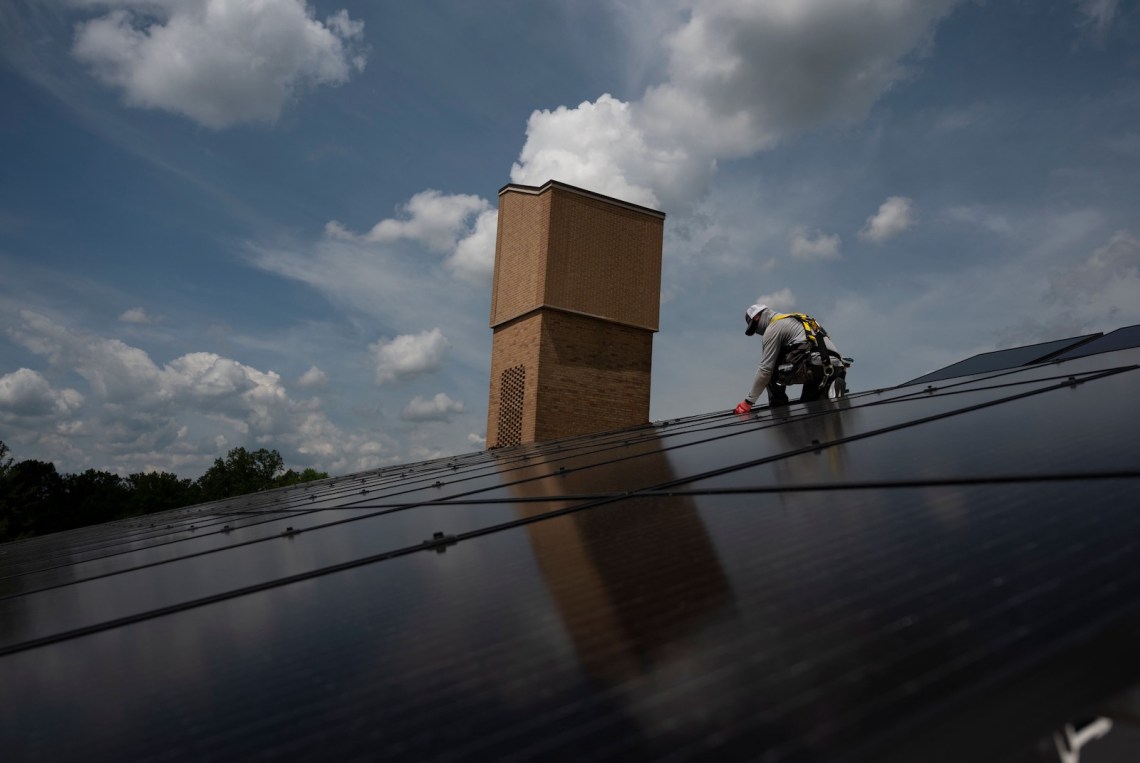
Incentives designed to encourage individual homeowners and consumers to embrace clean energy have been, for the most part, extinguished. Rooftop solar tax credits will expire at the end of this year, instead of ten years from now. Solar installers have already started layoffs, anticipating the decline in residential demand for photovoltaics, and a prominent representative for US solar panel manufacturers says it will “devastate” their industry. Tax credits to encourage the purchase of electric vehicles will vanish completely at the end of September.
The bill also kneecaps the future build-out of large-scale solar and wind energy in the United States. Larger solar and wind installations now either need to begin construction within a year or be operational by the end of 2027 to qualify for investment and production tax credits—deadlines that could effectively kill many projects. Still more lethal are the complex new “foreign entities of concern” requirements that mostly start on January 1, which exclude the use of many Chinese components and equipment in new projects. Since so many wind and solar projects rely on Chinese imports—four fifths of the world’s polysilicon is produced in China—few will be able to overcome these restrictions, which is likely the intended outcome. The OBBBA largely preserved tax credits for battery storage, geothermal, hydropower, and nuclear projects, and kept the “advanced manufacturing” credits that the IRA deployed to encourage more domestic manufacturing of batteries and other energy technologies. And yet it subjects all those projects immediately to the same onerous “foreign entity of concern” requirements.
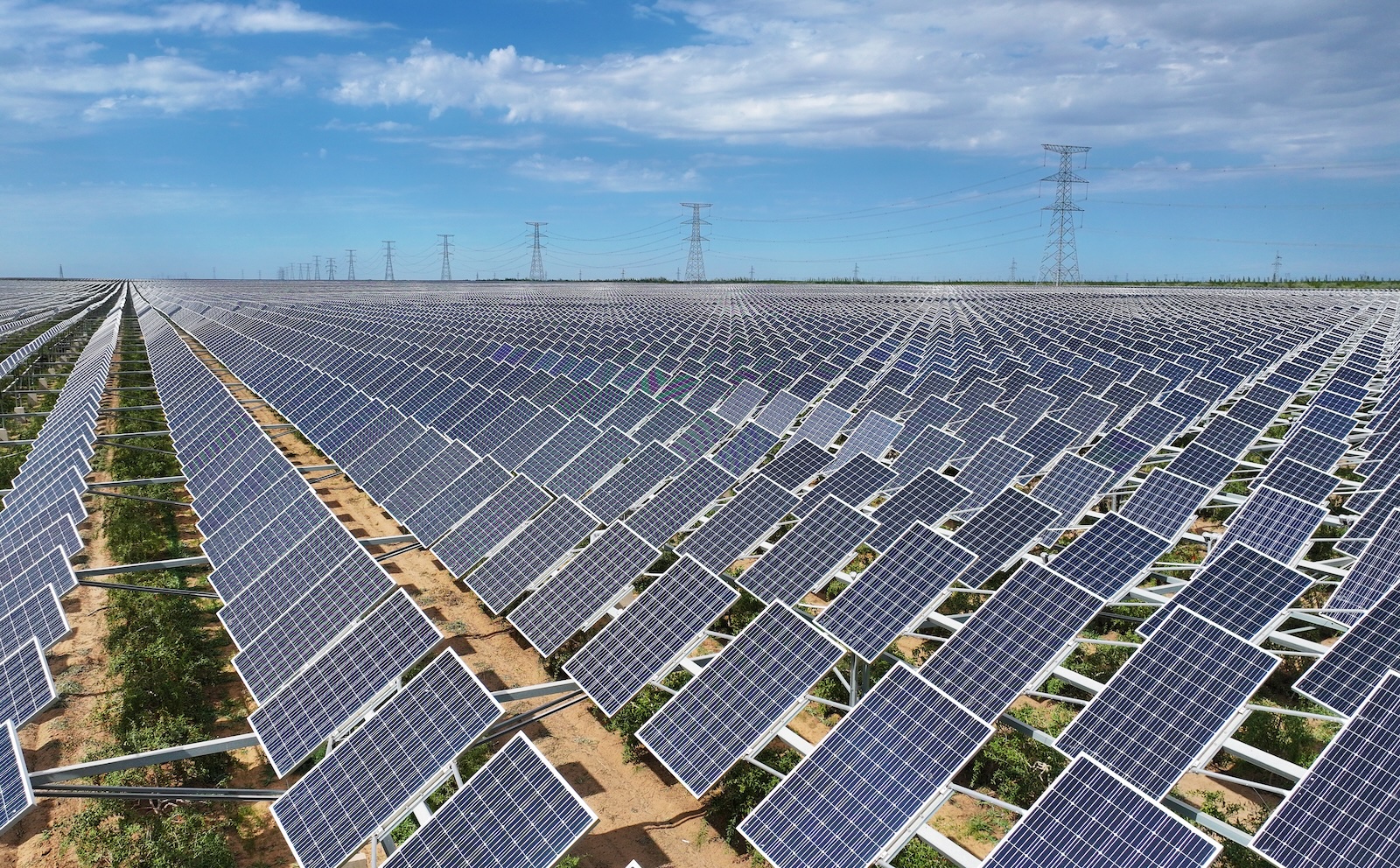
Yuan Hongyan/VCG/Getty Images
Goji berries growing under rows of solar panels at an agrivoltaic power project in Yinchuan, China, July 17, 2025
Clean energy has acquired too much momentum to simply grind to a halt. Last year 94 percent of newly installed electric capacity in the US was from solar, batteries, and wind. The solar and wind industries will survive, but thanks to the new obstacles that Trump and the GOP have thrown in their way, they will build out more slowly. Carmakers will still produce electric vehicles, and consumers will still buy them, though at markedly lower rates. Jesse Jenkins, a professor and energy modeler at Princeton, predicts that the demise of the tax credits could shrink the US market for EVs by up to 40 percent within five years. A contraction on that scale would deal a huge blow to the US auto industry, which has already invested hundreds of billions of dollars in retooling assembly lines and supply chains to meet growing demand for EVs.
The tax credits for solar arrays, wind farms, and electric vehicles were responsible for the bulk of the anticipated emissions reductions from the IRA. But the OBBBA’s climate obstructionism extends beyond the loss of clean energy incentives. The bill repeals all funding for the EPA’s Greenhouse Gas Reduction Fund, which helps states, cities, tribes, and towns undertake their own emissions-cutting measures. It also ends two IRA programs designed to reduce methane emissions from oil and gas operations. All told, according to Jenkins’s research group at Princeton, we can expect an extra seven billion tons of greenhouse gas emissions by 2030 thanks to the “Big Beautiful Bill.”
*
Long before Americans experience the destabilizing effects of those extra molecules of methane and carbon dioxide, they will feel the effects of the GOP’s disinvestment in the country’s power grid. On his first day in office Trump declared a spurious “energy emergency,” which he cited to justify a spate of executive orders freezing permits for wind projects, discarding rules on pollution from oil and gas wells, and extending the lifespans of coal plants that were about to be shut down. There was, of course, no emergency. The US was—and is—awash in oil and gas, and thanks to the IRA’s catalytic effects and the plunging costs of renewables and batteries, its clean electricity supply was poised for accelerating growth.
But with the passage of his bill, Trump has dramatically increased the likelihood of a genuine crisis in the years ahead. After nearly two decades of remaining flat, electricity demand is finally rising, driven by new manufacturing, electrification of transport and home heating, and a boom in data centers to power Grok, ChatGPT, and all the other AI programs that now pop up unbidden in our daily lives. The phaseout of all those tax credits will upend the economics of new solar, wind, and storage projects that developers have proposed to help meet that new demand. Fewer will now get built, leading to a shortfall in new capacity. In 2035, according to estimates by the Rhodium Group, the amount of clean electricity on the US grid will be 57 to 62 percent lower than it would have been without the OBBBA. Energy Innovation, a research firm, estimates that the megabill will result in the loss of 340 gigawatts of new electric generating capacity between now and 2035—equivalent to more than a quarter of the current capacity of the entire grid.
Advertisement
After the solar and wind credits expire, some analysts predict a freeze in a range of new projects. Additional fossil fuel and nuclear plants can’t be constructed quickly enough to take their place. The supply chains for building new gas-fired power plants are snarled: whereas solar and wind projects can be built on the order of twelve to eighteen months, wait times for new gas turbines are currently five to seven years. Inadequate supply plus surging demand will inexorably lead to higher prices for electricity customers.
Electric bills are already rising sharply. During the first half of 2025, utilities have requested approval from their regulators for a record-high $29 billion in rate hikes, according to a new report from the nonprofit PowerLines, compared to a $12 billion hike during the first half of 2024. One recent analysis found that utility bills in every state will rise because of the GOP’s megabill; customers in some states will suffer price increases of over 20 percent. There’s also a real risk that the US will suffer more frequent power outages. Some energy experts have already dubbed it the “One Big Blackout Bill.”
Perhaps the GOP lawmakers who voted for the legislation are betting that they won’t be blamed for the closure of battery plants or the loss of tax revenue and jobs—that voters won’t connect the dots and punish them for spiking energy bills. (Maybe voters will instead point fingers at Meta and the other AI hyperscalers building energy-slurping data centers in Ohio, Texas, Georgia, and northeast Louisiana, some of them nearly the size of Manhattan.) The fragmented information-delivery environment we now live in makes that a reasonable bet. Republican legislators may very well escape any political penalties for their votes. There are signs already, as The Washington Post has reported, that rural voters aren’t blaming Trump’s Medicaid cuts for the loss of their hospitals.
But it would be foolish to assume that rolling blackouts and spiking electricity bills will fail to produce any political backlash. In 1973 OPEC’s oil embargo on the US sent gasoline prices upward and left Americans waiting in hours-long lines at the pump. That sent the country into a two-year recession and nearly a decade of inflation and dampened growth, bookended by another oil price shock in 1979 tied to the Iranian Revolution. Those experiences had a profound effect on the American psyche. The postwar era of energy abundance screeched to a halt; suddenly consumers had to reckon with not just the idea but the reality of limits on their consumption—and on the size of their cars.
The 1970s energy crises reshaped both American politics and global geopolitics. They forced political leaders to diversify energy sources, prioritize efficiency, and realize that relying too heavily on oil from certain parts of the world made the US vulnerable. In the process they launched a quest for “energy independence” that picked up speed during the Nixon and Carter administrations and became a shibboleth for every president since. Among the many now familiar legacies of that upheaval are fifty-five-mile-per-hour speed limits and fuel economy standards for cars. The crisis also gave birth to the Department of Energy in 1977 and launched federal funding for research into energy-efficient buildings and “alternative” energy sources like solar and wind, which would bear fruit decades later; its inflationary effects might also have helped get Ronald Reagan elected to the White House.
A more obscure outcome of the crisis was that regulators now require electric utilities to develop long-term plans to ensure their power supply can meet forecasted demand. Ever since, fossil fuel companies and coal- and gas-heavy utilities have often warned regulators and lawmakers and grid operators that without building more fossil fuel plants they will struggle to “keep the lights on.” That phrase is a power company’s time-tested trump card. It’s effective because most consumers care more that the power stays on than they care about where it comes from.
*
Globally, the passage of the OBBBA won’t stop the clean energy transition from picking up speed. Solar deployment may slow down in Trump’s America, but in the rest of the world it is spreading like wildfire, accounting in 2024 for 70 percent of new electric capacity added globally. The reason is straightforward: solar and batteries are simply getting too cheap. The average cost of new solar-and-storage facilities dropped 22 percent from 2023 to 2024 alone.
Most of those facilities were built with components from Chinese firms. Well before Trump took office for the second time, China was already dominating the financing of new energy infrastructure projects in Africa, Latin America, and Southeast Asia. (China’s “green soft power” will only grow in the aftermath of Elon Musk’s destruction of USAID and the US State Department’s recent dissolution of its climate negotiations office.) China is by far the world’s top exporter of solar panels. It is also the top exporter of batteries, battery minerals, and electric vehicles. The four biggest wind turbine manufacturing firms are based in China. Domestically, too, China is a clean energy juggernaut: it installed more than half of the world’s new solar capacity in 2024 and is, according to one recent report, building three quarters of all the solar and wind projects underway worldwide. Jim Farley—the CEO of Ford, a company that for much of the past century has been synonymous with US industrial might—recently confessed at the Aspen Ideas Festival that China’s prowess in making low-cost, high-performance electric vehicles is “the most humbling thing I’ve ever seen.”
Chinese officials were already signaling soon after the election that they would capitalize on Trump’s coming retreat from global climate diplomacy. But the Big Beautiful Bill presents them with a far bigger opportunity than Trump’s widely expected withdrawal from the Paris climate agreement. In concert with its wholesale abandonment of climate science across federal agencies, the Trump administration’s gutting of the IRA cedes the fields of both climate leadership and clean energy innovation.
The Big Beautiful Bill echoes Trump’s obsession with tariffs in its headlong flight backward in time. It shackles the US to a nineteenth-century energy system—burning coal, gas, and oil in power plants and internal combustion engines—even as China barrels ahead toward near-total dominance of the supply chains for solar, wind, batteries, and EVs. In the coming decades, the world’s climate trajectory may well depend on how China chooses to wield this unexpected gift.