

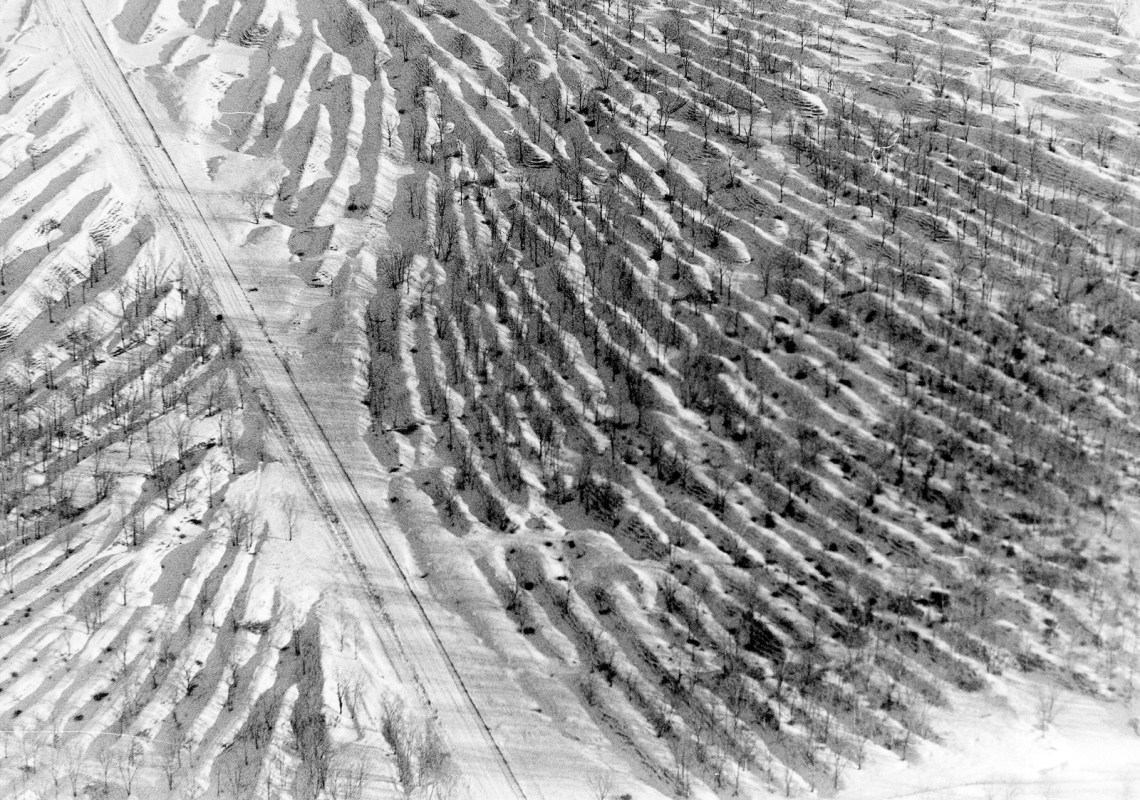
When I was knee-high to a grasshopper, we lived in a house in the country—on a rural road on the outskirts of Springfield, Illinois, where the water was from a well, the street name was a number, and the neighbors were farmers. The flat plain of our mowed backyard smudged from tamed grass to tall trees, which marked the edge of my world. I imagined those trees were a primeval forest, its trunks and branches witnesses to the land’s past. I was rarely brave enough to wander more than a few paces into their dark understory, but close to the edge I dug in the dirt looking for arrowheads and fossils. The older I get the more I think about the past of this land that we tread and build upon, and profane.
I had never thought of the state capital as a former coal-mining center, like other places in Illinois with evocative names like Coal City or Carbondale or Diamond. To me Springfield was a glorified farm town. If you drive ten or twenty minutes in any direction from the white-domed capitol building, you’ll likely end up in a field of corn or soy. And yet in 2022 a local high school had to close because the structure dropped nearly two feet over the course of two weeks. Suddenly doors and windows wouldn’t close, water started to back up, and the building had to be evacuated. The school had been built over an old coal mine and was experiencing subsidence, most of which occurred, officials said, during a single day over summer break.
I came across a couple of articles about the school, one of which included a link to a map from the Illinois Geological Survey. That is when I learned that most of Springfield, outside of the historic downtown, is a patchwork of shallow and deep coal mine cavities. For nearly a hundred years, from 1865 to 1964, laborers dug these mines, mainly using the room-and-pillar technique: excavating most of the coal but leaving columns of it in place to hold up the ground and protect against subsidence. But over time, as groundwater swirled and pooled, the pillars eroded and the ground shifted. Many Illinois cities have similar subsidence problems, given that coal deposits sit under some two thirds of the state’s territory. The US Energy Information Administration estimates that Illinois is the state with the second-largest recoverable coal reserve, although its mining heyday is long past and only about twenty of its mines still function.
As I pored over that map of the mines, I looked up the landmarks of my childhood. My high school was fine, but my middle school was firmly marked in red to denote the presence of man-made cavities underground. Our church, one of the oldest Black churches in the state, was marked as yellow, in the margin of error; the mapmakers weren’t sure if tunnels extended that far. My childhood house was also on uncertain terrain—a yellow expanse splattered with amoeba-shaped blobs of dull red. And the park where my three siblings and I used to play? That one, marked good and red, is well documented as a site where, during the mid-nineteenth century, enterprising miners harvested outcrop coal protruding from the surface of the earth.
I have read that people in the coal industry gave their product a nickname: “buried sunshine.” It feels like an obvious attempt to deflect from coal’s association with human-made gray skies, asthma-producing smoke, waterways filled with toxic ash, and, of course, climate change. But the term does make a kind of sense. The plants that make up coal grew thanks to solar energy more than 300 million years ago. It has always seemed obscene to me, this idea of digging up what was buried in a past so long gone, just to be able turn on the lights or power the air conditioner. Of course I do it, or it is done for me. But I can’t help seeing those black rocks as wonders, messengers from a world we have forgotten.
*
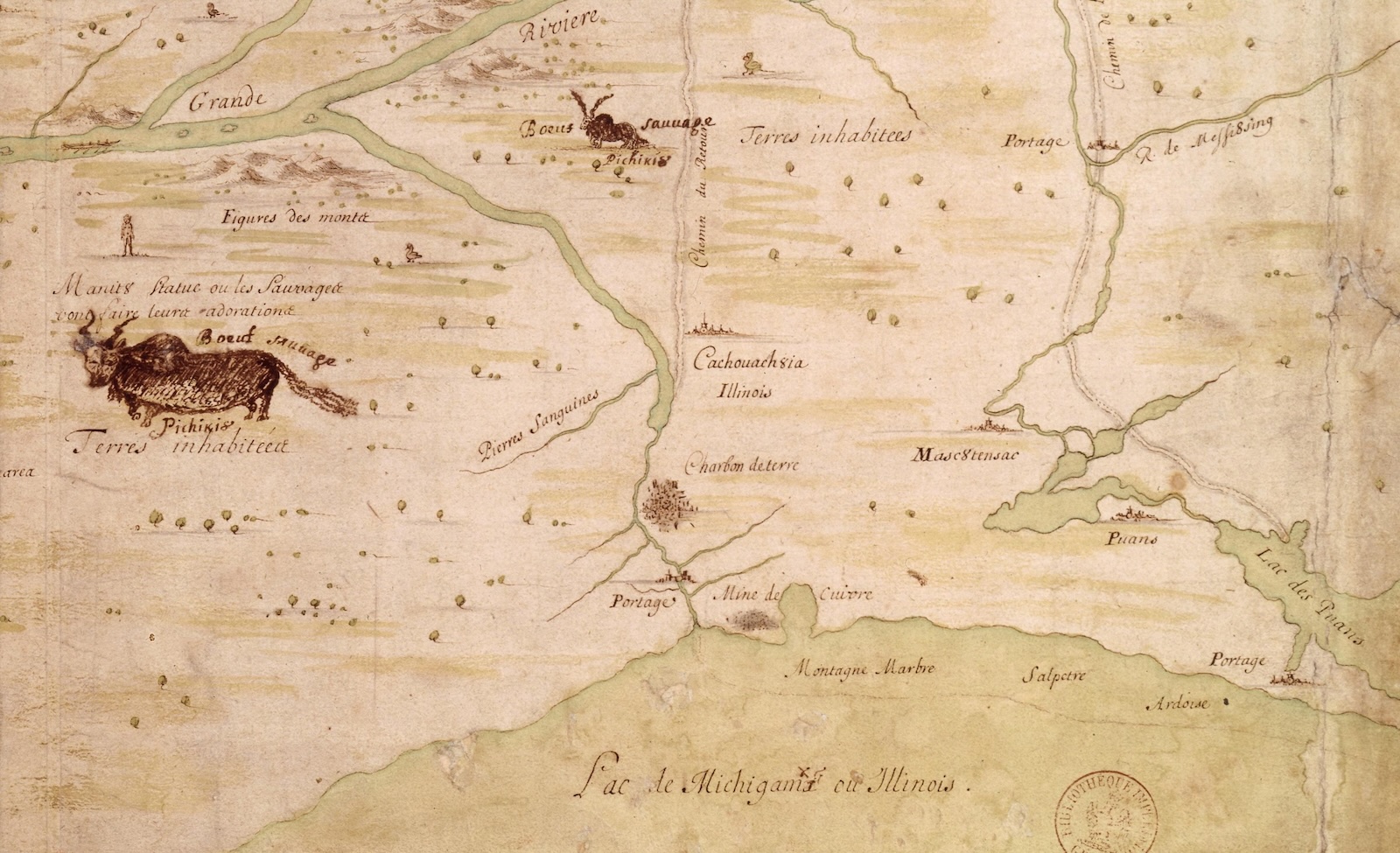
The first written reference to coal in Illinois, indeed in the whole of the present-day United States, dates to some 350 years ago, when the French Jesuit missionary Jacques Marquette and the Quebecois fur trader Louis Jolliet traveled south and west from the Straits of Mackinac, which connect Lake Huron and Lake Michigan, in search of what some Indigenous people called the “mitchi-sipi,” or the great river. When they found it, the river was teeming with sturgeon and other fish for which the French had no name. On the hand-drawn map attributed to Marquette and other missionaries, brawny buffalo, ducks, trees, and hills dot the page with much more whimsy than one might expect from clerics. They also noted where natural resources might lie—iron, copper, and charbon de terre, or coal.
Advertisement
In his journals Marquette wrote that the first people they met on the river called themselves the Illinois, a name later mapmakers would borrow to characterize both sides of the river’s upper and middle reaches, calling the whole thing “le Pays des Illinois.” Marquette described a visit to one of the Illinois’s villages: their ceremonial pipes; their cuisine of sagamité (a sort of corn porridge), buffalo meat, and fish; their animal skin dresses. He was gifted—and willingly took—a “little slave,” a boy about whom he says nothing else.
Library of Congress
A detail from a map of Louis Jolliet and Jacques Marquette’s expedition down the Mississippi River, including, at center, an indication of where coal reserves lie, 1673
As befits a missionary, Marquette dismissed the Indigenous gods and spirits. “For each has his own god, which they call their Manitou,” he wrote. “This is a serpent, a bird, or other similar thing, of which they have dreamed while sleeping, and in which they place all their confidence for the success of their war, their fishing, and their hunting.” Algonquian peoples across North America believed in the concept of the manitou, and the Anishinaabe writer Basil H. Johnston has written that outsiders like Marquette didn’t understand its breadth. In his definition manitous are “of a substance, character, nature, essence, quiddity beyond comprehension and therefore beyond explanation, a mystery; supernatural; potency, potential.”
In the early 1700s, about thirty years after Marquette’s voyage, other Jesuits settled on the Mississippi River’s shores in an area that was home to a group of Kaskaskia—members of the Illinois Confederation—and named a new town after them. French merchants soon followed, and eventually the infrastructure of the French colonial government did, too. This outpost of voyageurs and trappers, clerics and craftsmen, and free and enslaved Indigenous people and Africans became the most prosperous settlement in the Illinois Country, or, as it was sometimes called, Upper Louisiana. The newcomers cleared prairies, built houses from trees and stone, grew and milled grains destined for New Orleans, exported beaver furs and bear oil to the metropole, rowed flat-bottomed boats and pointy pirogues, and mined lead in nearby quarries—especially useful for firearms, which were needed for wars with the British and Indigenous nations.
In a 1732 census enslaved people made up about half of the region’s population. The biggest slaveholder in the Illinois Country was the Jesuit order itself. Official documents do not name most enslaved people; only sometimes do they distinguish a “Negro slave” from an “Indian slave.” The British conquered Illinois Country in the Seven Years’ War and lost it to the Americans during the Revolutionary War. Slavery persisted under each regime.
None of this history was taught to me in school. I was not taught that this free state had grandfathered in the enslaved status of many “French Negroes,” or that southerners who brought enslaved people to Illinois converted their status to a kind of an indenture that resembled slavery in all but name. I was not taught that the new state had some of the most restrictive Black Laws of any in the north, including one that prevented free Black people from settling there unless they could pay between $500 and $1,000 as a bond and required them to carry a Certificate of Freedom at all times. All of this happened not in Confederate territory but in a state that still congratulates itself for its association with the Great Emancipator.
*
Springfield does not allow you to forget its most distinguished citizen, the sixteenth president of the United States. Dozens if not hundreds of businesses have borrowed his name; the monuments to his life are many. My favorite is a statue that stands at the entrance to the state fairgrounds, a colorful thirty-foot fiberglass Abe, skinny and awkward in his shirtsleeves, toting an axe—the better to split those rails!—the paint so bleary that it looks like his face is melting.
Even our schools had a distinctly Lincoln-centered pedagogy. Teachers took us on trips to see the many Lincoln sites: a reconstruction of the village where he lived, the law office he shared with an associate, his two-story clapboard house (for a time, my father had a law office just down the street), the State Capitol building where he was a legislator, the train station from which he departed east in 1861, and his tomb, complete with an obelisk and a massive bronze bust.
The bust’s sculptor, Gutzon Borglum, is best known for desecrating Tȟuŋkášila Šákpe, or the Six Grandfathers Mountain, an important spiritual site of the Lakota. For them the mountain represents the deities responsible for creation—North, South, East, West, the sky, and the ground. Borglum disregarded those deities when he ordered workers to detonate explosives on the mountain and dig in the rockface with pneumatic hammers for his “Shrine to Democracy” on what became Mount Rushmore. This was his second such shrine—after one on Stone Mountain in Georgia dedicated to the Confederacy.
Advertisement
The Lincoln sites we visited most often were in downtown Springfield. During field trips we walked through the old town square, where historical markers and plaques abound, mostly about the lives of Mr. Lincoln and his contemporaries. I went back to that square recently and spied a plaque that I didn’t remember from my childhood. It commemorated a visit in late September 1838 from eight hundred people of the Potawatomi Nation who were being forcibly marched from their homes in Indiana to Kansas. The government agent overseeing the emigration wrote in his journal about the visit: “The wayfares were covered with anxious spectators, so much so indeed as to threaten for a time to impede the progress of the Emigration.” Along the way a marcher died nearly every day from hunger or heat exhaustion or illness, so many that eventually the Indiana historian Jacob Piatt Dunn would call it the Trail of Death.
By then Potawatomi bands from Illinois and Indiana had already been pushed out to make space for white settlers. In 1832 the Kaskaskia were persuaded to sign a treaty removing them to the other side of the Mississippi River. Other nations had been forced to leave as well, whether by treaty or war, including the Chickasaw, Ho-Chunk, Kickapoo, Mascouten, Menominee, Meskawki, Miami, Sauk, and Shawnee, until their communities were gone from the area.
Kaskaskia, in other words, was a place where Indigenous and Black experiences of oppression and agency once flowed together. Their twin subjugations went unacknowledged in the official histories about the new state and its government, which denied them citizenship and even full personhood.
*
Many historians believe that commercial coal mining in Illinois began in 1810 along the Big Muddy River, which is about thirty miles south and east from Kaskaskia as the crow flies. A white settler named William Boon and a Black man named Peter—referred to either as Boon’s slave or as his indentured servant—mined outcroppings of coal, loaded their haul into a flat-bottom boat, and sailed with it downriver to New Orleans.
It would take the Industrial Revolution, which came later to the US than it did to Europe, for coal to become central to the state’s economic development. The year before the Potawatomi Trail of Death, the state assembly allocated millions of dollars to build the first railroads in Illinois, including one that would pass through Springfield. Coal was needed to power those trains as well as to turn turbines in mills and factories all over the country.
Industrialists soon touted the new state for having lots of the stuff, hidden underneath the prairie and its claggy soils. More white people arrived, many of them recent immigrants from Europe, and found work in the mines that were transforming the country. The amount of coal produced in the state mushroomed from just 14,000 tons in 1838 to more than 25 million tons in 1900; during the late nineteenth and early twentieth centuries Illinois was, after Pennsylvania, the second-largest coal producer in the nation.
In 1910 a recent Harvard University graduate named Joseph Husband wrote a series of articles in The Atlantic Monthly about his experience working in an unnamed Illinois coal mine, a job he had taken because he was interested in “learning by actual work the ‘operating end’ of the great industry.” Recounting laboring alongside men “drawn from many nationalities” in “the darkness of the underworld,” he observes that the miners were fine-tuned to the mystical. They often saw supernatural beings underground, all determined by their own traditions: fairies, gnomes, and tommyknockers—dwarves who hide tools, blow out lights, and sometimes bury their pots of gold. Husband said that there were “many” Black miners, and they especially feared the “h’ants” that dwelled in an area of the mine where, some years prior, two workers had been crushed by tons of rock when a passage collapsed. They refused to go near the place.
Piemags/Alamy Stock Photo
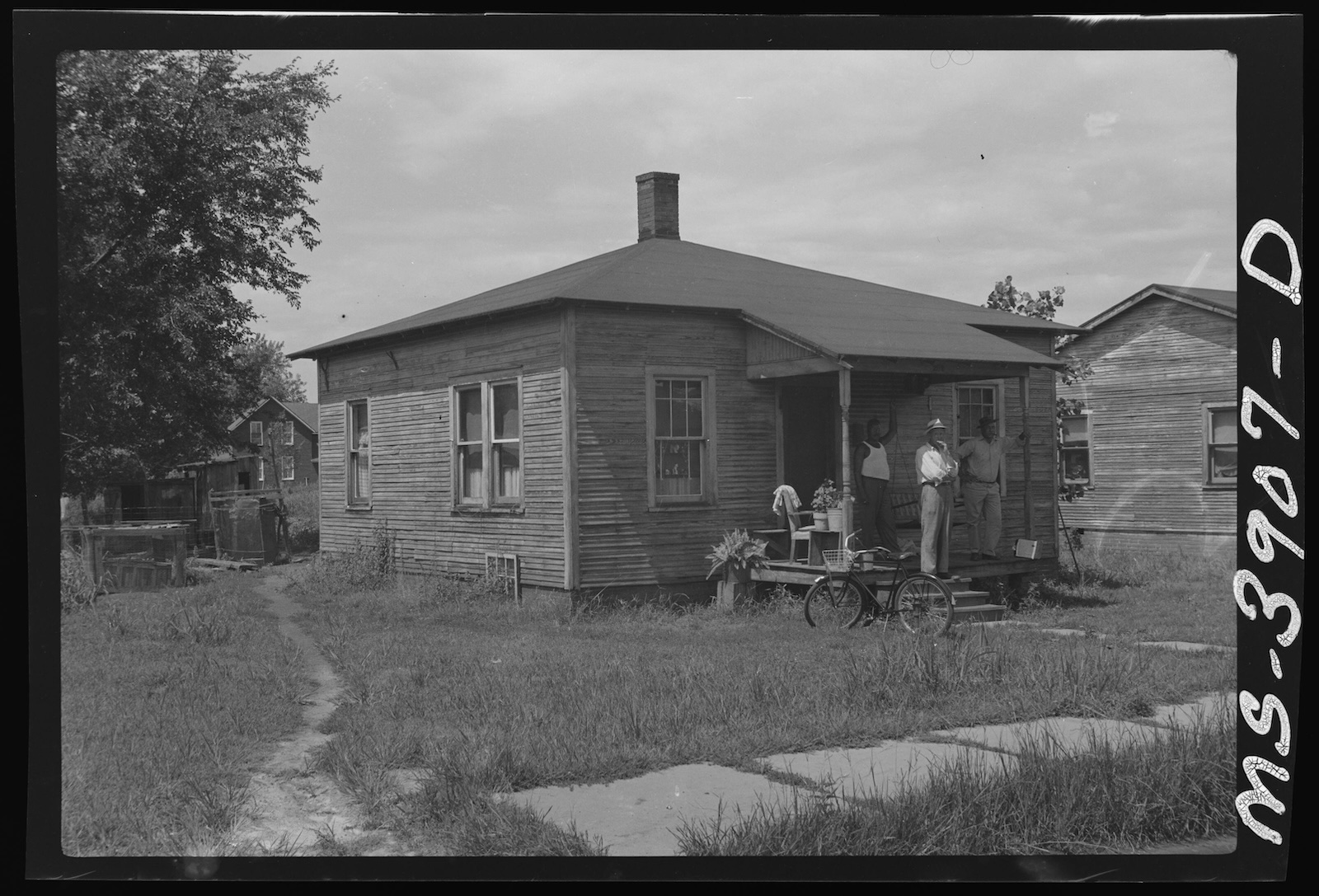
Black company housing at a mine operated by the Moffatt Coal Company, Sparta, Illinois, circa 1940s
Over time coal mining employment declined in Illinois, as it did across the country. Mines closed because of the emergence of other forms of energy, such as fuel oil and natural gas, and because of increased mechanization, to which smaller mines struggled to adapt. Yet although there are fewer mines and miners, coal production continues in the state. In 2023 Illinois mined more than 36 million short tons of coal, making it the country’s fourth-largest coal producer.
I have no ancestral connection to coal mining. My knowledge of it is drawn from Hollywood movies and documentaries and a lot of bluegrass songs. But when I learned about the extent of the coal mines hidden underneath Springfield, I asked my mother if we knew any Black miners. She could not think of any—neither from our Baptist church nor from the Urban League, not even from the NAACP committees that she participated in. (She does know a few white miners and ex-miners.) Certainly, many of the early coal miners, like Peter on the Big Muddy River in 1810 and those men in Husband’s book, had been Black, and I wondered why it was now so difficult to find Black people who continued in the trade.
Online I found at least a dozen small coal museums around Illinois, mostly county or single-mine affairs. But one stood out for claiming the whole state as its field: the Illinois Coal Museum in Gillespie, about halfway between Springfield and St. Louis. It took me forty-five minutes to drive there, down the interstate and along a back road. The museum, which occupies a red-brick former bank building in the old downtown, sported on its exterior side wall a bright orange WPA-style painting of a miner in profile, his jawline as angular as his pick. Dave Tucker, the museum’s director, told me that most visitors stumble in from Route 66 tours, and they tend to be retirees of a paler extraction. “We don’t get many visitors who look like you,” he said. Per the latest census data, not a single of Gillespie’s 3,118 citizens is Black.
Inside I was confronted with a jumble of memorabilia, mobiles, and an unrealistic replica of a mine shaft. The region has a strong history of organized labor; about twenty-five miles due east from Gillespie is Panama, where the future president of the United Mine Workers of America (UMWA), John L. Lewis (no relation), got his start. About ten miles to the south is the town of Mount Olive, the resting place of Mother Jones. Gillespie itself is the birthplace of the Progressive Miners of America.
Tucker was a wonderful guide, full of stories about nearly every object. I was intrigued by small things: the miners’ stackable metal lunch boxes, the most fetching one a muted heather blue; an illustration of a tree with a trunk made of coal and coal-derived products as branches, including linoleum, laughing gas, and mothballs; an old miner’s cap with a head lamp made with an oil wick and another made with a carbide lamp full of gunpowder (essentially a little bomb that miners wore on their heads); an illustration of subsidence problems in the Gillespie area. “There were a lot of ways to die in a mine,” said Tucker—those head lamps, the explosive coal dust, the poisonous gases that seeped silently through the rocks, mine collapses, and the fine particles that got into miners’ lungs and killed them slowly.
I looked for the Black people in the museum and found them in a display about mining conflicts in Virden in 1898 and Pana in 1899, two towns not far from Springfield. In both cases, when the UMWA local struck, the mine owners hired non-union Black workers from Alabama, many of whom didn’t know they were being recruited as strikebreakers, and brought them to town protected by armed security. The striking miners attacked the strikebreakers and their escorts, and in the ensuing violence several people were killed or injured. Newspapers across the country reported on the Illinois Mine Wars. In these parts of the state white miners began to view any Black person suspiciously. A local journalist reported that “the men have gotten the Afro-Phobia so badly that the colored porters on the trains crawl under the seats when going through town.”
After the conflicts in Pana and Virden, white citizens drove all the Black people out of both towns—an ethnic cleansing. No Black person was to be seen after the sun set, or even, in many cases, when the sun was up. Mount Olive, where Mother Jones is buried, became a sundown town too. So did other small towns that collar Springfield: Auburn, Carlinville, Divernon, Pawnee, Sherman, Thayer, Williamsville. And, yes, Gillespie. All of them were former coal towns. Springfield did not become a sundown town, but it did become the site of a race massacre in August 1908, during which white inhabitants shot and lynched Black people, burned and destroyed dozens of Black-owned homes and business, and razed entire city blocks in Black residential areas. At least two thousand Black people became, for a time, refugees in their own country.
In 1917 Carl Sandburg wrote a poem inspired by the Pana unrest, channeling the voice of Henry Stephens, the leader of the Black miners there:
Springfield is Abraham Lincoln’s town.
There’s only eight mines out of twenty
In Sangamon county
Where the white miners
Let a negro work.
If I buy a house right next to the Peabody mine
That won’t do no good.
Only white men digs coal there.
I got to walk a mile, two miles, further
Where the black man can dig coal.
By the time my relatives came up from the South a few decades later, they must have known better than to be seduced by mining jobs. Instead they headed straight to the segregated metropolis of Chicago, with its moody lake, its whistling wind, and its parks that reminded them of the southern countryside. They brought their determination, their optimism, and their faith, building new lives on the state’s uncertain substrata of violence to people, violence to the land.
*
In the early spring of 2023 I convinced my sister to go on a road trip with me to parts of southern Illinois I’d never seen, areas near old Kaskaskia, although that town was mostly reclaimed by the Mississippi in the 1800s. We followed winding, lonely two-lane roads that crisscrossed railroads and waterways and fields likely soon destined for corn and soy crops, as we headed into the American Bottom, a lowland that is part of the Mississippi’s floodplain. We constrained our travel to daylight hours: our father, who visited prisons in these areas as a public defender in the 1970s and 1980s, said that informal mob justice could be more forceful than the law he knew.
At one point my sister and I stopped to go on a hike. The trail looked simple enough from the parking lot, but what had seemed a few stories of stairs turned out to be several, at the end of which was a steep dirt trail that went straight up. Every time we thought it was leveling off, it climbed further. We finally made it to the top of a bluff, out of breath and with our legs on fire, and stepped onto a meadow covered in mostly dried-out grasses and shrubs—big bluestem, butterfly milkweed, purple coneflower. It was a remnant of the loess hill prairie, nourished by windblown silt, that had developed for thousands of years on the limestone cliffs that guard these lowlands. This inaccessible patch had escaped the fate of most of the prairie: no steel plow had broken the land here.
I looked down at the waterlogged fields laid out below us in a checkerboard and at the levees beyond them that stood as sentries against incursions from the great river. In the distance a train had stopped on the tracks, and a line of open cars full of coal stretched across the horizon. I could see its beginning, but not its end.