

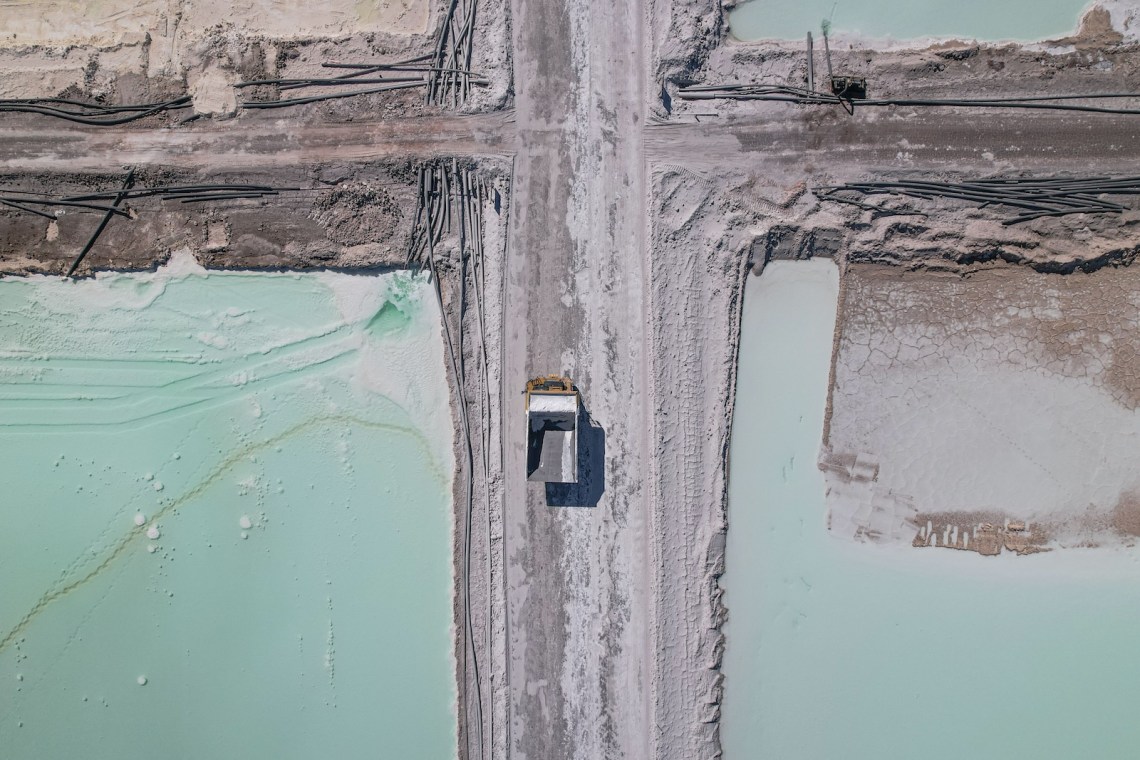
Lithium is the third element in the periodic table. It is the lightest, least dense metal—although it is never encountered as such in nature, since it’s too reactive to exist without being bonded in a compound. Lithium ions and minerals appear in an impressive range of environments: hard rocks, liquid brines, soft clays, and even, at very low concentrations, oceans. It has an equally impressive number of uses, from oven-safe cookware to psychotropic pharmacology to the role it is now playing on history’s grand stage: as an essential ingredient in rechargeable batteries.
The renewable energy transition depends on electrification—and electrification depends on rechargeable batteries. If we are to have any chance whatsoever of avoiding the most catastrophic climate scenarios, we have no choice but to slash carbon emissions, especially in the transportation sector, the single largest contributor to the US carbon footprint and the second largest source of global carbon emissions. And the batteries that make it possible for cars to run on wind and sun instead of fossil fuels depend, in turn, on refined, high-purity lithium compounds.
Lithium batteries are also essential for the energy sector. As our energy systems incorporate more electricity from intermittent sources like sun and wind, storage is crucial—otherwise the power would only be available when the sun is shining or the wind is blowing. Large, “utility-scale” batteries are thus vital to balance the grid.
The International Energy Agency (IEA), an intergovernmental organization, predicts that global demand for lithium will skyrocket as the green transition accelerates. By the IEA’s estimate, demand in 2050 will be ten times that in 2023—the single largest growth forecast of any of the “critical minerals” the agency surveyed. Lithium is not the only energy transition material that is forecasted for increased demand. The manufacturing of solar panels, wind turbines, and electric vehicles, to name just three essential technologies of our renewable era, requires a veritable periodic table of inputs wrested from the earth’s crust: lithium, graphite, copper, iron, rare earth elements, nickel, cobalt, bauxite, silicon, manganese, and many more. The copper sector, which already serves an enormous global market, will need to grow by 150 percent by 2050. We will need twice as much aluminum in 2050, refined from mined bauxite, as we produce today.
Skyrocketing demand means more mines. Benchmark Mineral Intelligence estimates that meeting global lithium demand in 2035 will require between fifty-nine and seventy-four new and fully operational lithium mines (the exact number depends on recycling capacity), compared to 2022, when there were around forty such mines. Looking at a range of minerals required for battery production, the analytics firm predicts that between 336 and 384 entirely new mines will need to be built and in production by 2035 to satisfy global demand for lithium, graphite, cobalt, and nickel. This would be in addition to fifty-four plants pumping out synthetic graphite (which, by the way, is made from coal).
And this is just for batteries. The World Bank provides similarly jaw-dropping forecasts for other renewable energy supply chains: solar panel production could require over 200 million tons of cumulative mineral demand by 2050, primarily aluminum (and secondarily copper). Wind turbines would consume as much as 350 million tons more iron—their single largest raw material input—in addition to 125 million combined tons of zinc, copper, aluminum, chromium, manganese, and rare earth elements. Every single supply chain of green technologies and infrastructures involves mining—and every kind of mining since the dawn of capitalism has brought with it boom-and-bust cycles, social conflicts, and environmental harm.
Extraction is the material foundation of a zero-carbon world. “Green capitalism” can therefore sound like an oxymoron. How can capitalism ever be green if even the technologies and infrastructures needed to harness renewable energy require digging several hundred new large-scale mines in the span of a decade?
Green capitalism does not mean that capitalism is becoming ecologically sustainable. Instead it refers to the emergence of new economic sectors and supply chains labeled as “green” because of their potential—proven or unproven—to help address the climate crisis, whether by decarbonization or adaptation. It likewise refers to a worldview. Promoters of green capitalism, from EV executives to mainstream policy wonks, see profit-maximizing firms and business-friendly governments as the main protagonists in the drama of the energy transition. Market-driven innovation, they insist, can save the planet without major changes in how our economy works.
And yet extractive frontiers are not just unfortunate blemishes on otherwise “clean” energy. Nor are they tragic but inevitable flaws in an otherwise virtuous economic system. They epitomize the reality of global capitalism: a mode of production that lays waste to the natural world upon which it relies. Testifying to the earthly origins and entanglements of everything around us, they caution us against the temptations of technical fixes, escape-from-nature fantasies, or the notion that we could achieve a purely post-extractive society. They link the brutal past of colonialism to the stark injustices of the green future—and the geopolitical battles pitting the Great Powers against emerging powers, as governments around the world try to find their foothold in the supply chains of the twenty-first century.
Advertisement
*
Will there be enough lithium to power the tens of millions of new electric vehicles slated for production by the end of this decade? In theory, the answer is yes. Lithium is not scarce. Deposits have been discovered on all seven continents, including Antarctica, and it is the thirty-third most common element in the earth’s crust and waters. Almost all the world’s lithium currently comes from a handful of countries (Australia, Chile, China, and Argentina), but the list is expanding, with lithium mining ramping up in Zimbabwe, Brazil, Canada, and elsewhere.
Notwithstanding these developments, the IEA expects that, based on existing and announced mining projects, lithium demand will outstrip market supply after 2030. The data analytics firm Wood Mackenzie predicts that this inflection point will come a few years later, in 2033; Benchmark Mineral Intelligence predicts it will arrive sooner, in 2028. Copper, too, will “fall significantly short” of global needs by 2040. This is part of what it means to call these raw materials “critical minerals”: experts have deemed them essential to energy systems, national security, or the broader economy, yet supplies are either insufficient or vulnerable.
Bringing new mineral supplies into the global market is rarely a rapid or smooth process. Depending on the country, it can take between ten and thirty years for the discovery of a new deposit to become a productive mine. Those lengthy time frames reflect the sheer range of things that, from a corporate perspective, can go wrong: permitting challenges, financing woes, community protest, labor strikes—not to mention increasingly unpredictable weather and water scarcities, which can disrupt operations. This by no means implies that minerals are always in shortfall. The underlying unpredictability means that supply can just as easily overshoot demand.
But the economics of critical minerals is not a simple matter of supply and demand. Today market dynamics take place in a world increasingly defined by the fusion of national security and economic policy that goes by the name “geoeconomics.” States compete against one another in a global contest to achieve national dominance over the supply chains for electric vehicles, solar panels, and semiconductors. To this end, governments cajole multinational corporations to invest within their borders—or send them packing if they’re too closely allied with an adversarial state. Amid these contests of economic and political power, marginalized communities and precarious workers are also demanding a say in the future of mining. The only certainty is volatility.
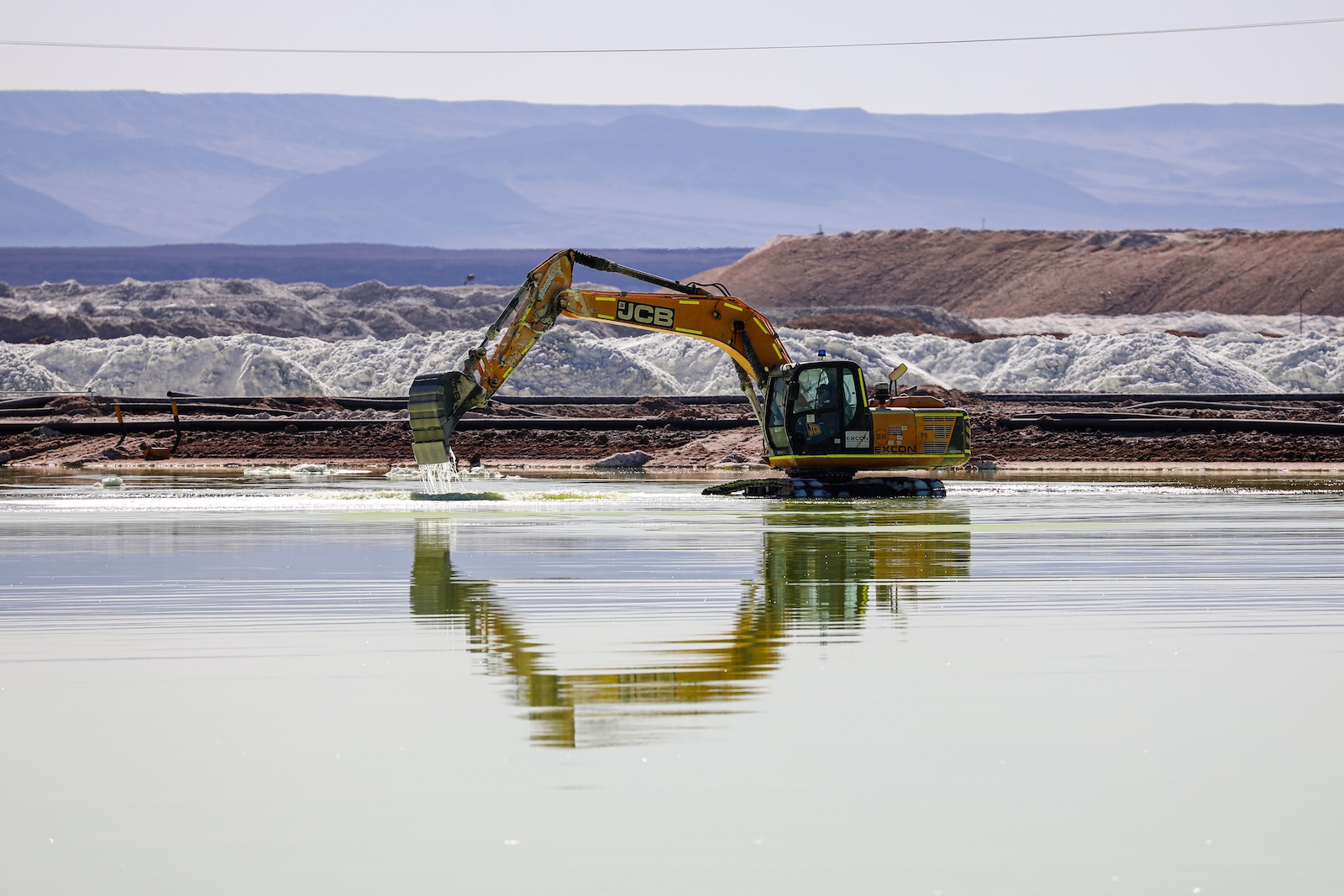
Lucas Aguayo Araos/Anadolu/Getty Images
A mining crane in Chile, July 29, 2024
The stakes of the mineral economy could hardly be higher. Imagine a world in the grip of recurrent shortages of the metals needed to build solar panels or electric vehicles. Especially in today’s geopolitical climate, interstate competition for dwindling reserves could get fierce. Governments might increasingly resort to trade protectionism—including outright bans on exports—or, worse, the use of force to secure access to raw materials. If affluent countries hoard resources, how will the majority of the earth’s inhabitants access renewable energy technologies? An undersupply of lithium, copper, or graphite would mean a slower and more uneven energy transition, with global consequences for our ability to mitigate the climate crisis.
Now, in contrast, imagine an alternate future of mineral abundance, in which electric vehicles have become more affordable to working- and middle-class people around the world. With the problem of scarcity removed, low- and middle-income countries also have access to the minerals so critical for renewable energy. With fewer tensions around supply chains, nations are willing and able to cooperate on emissions targets and ensure access to climate finance. In this world of plenty, vast deployment of green technologies generates economies of scale that further drive down cost, buttressing not only the economic feasibility but also the political popularity of the energy transition, all while spreading its benefits more broadly.
These radically different futures map onto two schools of thought about the minerals that undergird the energy transition. One set of experts contends that there are enough minerals; the other predicts chronic gaps between available supplies relative to growing demand. These are simplifications, of course. For example, the optimists acknowledge the possibility of temporary shortfalls. But as self-identified “ecomodernists,” they have faith in the combination of market forces and technological progress to drive new mining and innovative substitutions. They point, for example, to the growing popularity of cheaper cathode chemistries, such as lithium iron phosphate, or to replacements for lithium altogether, such as sodium batteries, which are growing closer to commercial viability.
Advertisement
The doomsday view, for its part, offers a few off-ramps from apocalypse. While the pessimists tend to present supply as a hard constraint, some among them see demand as more malleable, embracing a philosophy known as “degrowth.” From this perspective, the best solution to mineral scarcity is to reduce consumption, particularly by curtailing the elite lifestyles that produce the largest carbon footprints: bans on private jets, caps on energy use, and an enormous shift from individual cars to mass transit. Degrowth, the thinking goes, would alleviate pressure not only on market supplies but also on the ecosystems, watersheds, and communities that bear the brunt of extractive harm.
Both the optimists and the pessimists have valuable insights. But they both miss the fundamentals of the political economy of extraction, because “Is there enough?” is the wrong question to ask in the first place. Extraction is never just about what’s underground. In any case, our understanding of “what’s underground” changes over time. Improvements in geological knowledge, innovations in mining techniques, and shifts in global markets create new extractive frontiers. In the mid-1950s the American geologist M. King Hubbert predicted that US oil production would “peak” in 1970—one of many moments of recurrent concern that oil supplies, whether in the United States or globally, were near exhaustion. Decades later the shale revolution, more commonly known as fracking, opened entirely new territories for oil and gas. These days the US is the world’s top oil and gas producer, with extraction of both exceeding the predicted 1970 apex. It is increasingly likely—and, from a climate perspective, eminently desirable—that demand for fossil fuels will dwindle before supplies do.
*
Discussions of green capitalism increasingly focus on supply chains. But what, precisely, is a supply chain? The term calls to mind a linear process that starts when raw materials are extracted or harvested and ends with a consumer purchasing a finished product (or, more accurately, discarding or recycling it). But although mining chronologically precedes manufacturing, it is manufacturing’s voracious appetite for raw materials that compels the extraction of resources to begin with. To drive this point home, some scholars call the zones where large-scale mining and agriculture take place “commodity frontiers.”
Rubber is a great example of this process. For centuries Indigenous peoples in the Brazilian Amazon had foraged wild rubber. They did so at a small scale, intermittently, and without recognition of property rights. It was not until the mid-nineteenth century that the growth in British, American, and European tire production (initially for bicycles, later and more massively for the automobile) drove a boom in Brazilian rubber. By the early twentieth century Brazil’s rubber exports came second only to coffee. The relentless demand from those downstream industries transformed the rubber extraction process. Corporations enslaved and otherwise coerced Brazilian laborers to tap rubber from trees in enormous plantations. The production of tires at the “end” of the supply chain drove extraction and exploitation at the “beginning.”
Over the past five hundred years, the world’s commodity frontiers have been remade many times over. From the late fifteenth through the mid-twentieth centuries, colonial and imperial powers often procured raw materials directly from the territories they conquered. Brazil, for example, lost its status as top rubber producer when the British Empire began to source domesticated rubber from its colonies in Sri Lanka and Malaysia.
With the takeoff of industrial capitalism, large corporations emerged as major players in the global hunt for resources. During the era of Fordism (circa 1913–1973), titans of industry attempted to establish their own mini-empires. With the goal of vertical integration, large corporations internalized various stages of production—including raw materials and energy. Ford’s River Rouge plant, completed in 1927, not only integrated the manufacturing of the car’s components but also produced the necessary steel onsite using iron ore and coal from Ford’s own mines. A year after bringing River Rouge into operation, Ford attempted to integrate rubber into his operations, too, establishing a plantation in northern Brazil. That effort, unlike the coal mines, ultimately failed.
The economic crisis of the 1970s brought Fordism to an end, prompting the reorganization of global supply chains. Innovations in finance, container shipping, and logistics allowed corporations to disintegrate, offshoring and outsourcing their operations not just across different firms but around the world. The result was the complex, spatially dispersed, “sliced and diced” network of supply chains we know today. These corporate strategies aligned with, and were enabled by, government policies that encouraged capital, raw materials, and finished goods to move across borders with minimal regulations. This logic of economic efficiency extended to extractive frontiers: mining would happen wherever it was easiest and cheapest, in low-income countries with abundant deposits and pliable governments.
Today it almost seems like history is running in reverse. Neither policymakers nor downstream firms trust those bywords of globalization, “free trade” and “open markets,” to ensure reliable access to lithium battery supply chains. Instead world powers like China, the US, and the European Union are actively encouraging lithium mining to take place within their borders. When I traveled to Brussels in late 2019, I learned that European policymakers aspired to “self-sufficiency” in critical minerals—a bold, perhaps unachievable goal for a continent that currently depends almost entirely on metals imported from abroad.
On the other side of the Atlantic, similar ideas were taking hold in Washington. It was Trump’s first term, and he had campaigned on economic nationalism: nostalgia for a bygone era of American manufacturing combined with xenophobia toward China, immigrants, or anyone who could be scapegoated for hollowing out domestic industry. Biden likewise embraced the domestic production of green technologies from mine to factory, with top officials openly criticizing the prior paradigm of free trade and globalization.
This push has only gained momentum. On the same day that he was inaugurated for a second term as president, Trump signed an executive order aiming to “restore” America’s “mineral dominance.” In both the EU and US, policymakers have particularly emphasized the strategic importance of onshoring critical minerals, with electric vehicles, their batteries, and their essential input of lithium taking center stage.
One might think that, if the affluent countries that have long benefited from faraway resource frontiers actually start bringing extraction home, the world order’s stark economic and ecological inequalities might begin leveling out: onshoring could in theory be a step toward a more even distribution of the harms and benefits of extraction. But extraction is not just distributed unequally between world regions, or between poor and rich countries. It is also experienced differentially within them. Expanding lithium mining in the southwestern US, with its intertwined legacies of Indigenous dispossession, toxic mining, and nuclear testing, neither repairs harm in the Global South nor advances the cause of global justice.
As important as it is to govern extraction better and to distribute its costs and benefits more equally, there is no escaping the need to reduce mining overall. Whether or not we should call such a change “degrowth,” it should be clear that the race for new frontiers is propelled by the relentless demand for raw materials to feed the factories of global capitalism that furnish consumer lifestyles, especially for the affluent.
*
The climate crisis, lithium mining, the energy transition, and, hopefully, something like climate safety: these aren’t sequential steps in a linear trajectory but intersecting processes unfolding at increasing speed, bumping up against one another in time and space. We are currently in what the energy systems analyst Emily Grubert calls the “mid-transition.” Renewables are being deployed, but fossil fuels remain dominant. Some corners of the global economy are being decarbonized, while others continue to spew emissions and warm the atmosphere. This likewise implies multiplying extractive frontiers. Fossil capitalism is painfully undead; the mines to supply green capitalism are still being built.
There is no one simple trick to escape our earthly entanglement with nature’s bounty, nor to dismantle power relations that have sedimented into their own force of nature. The implications are quite material. The impacts of lithium mining—on water systems, biodiversity, and Indigenous land rights—will be intensified by the very climate crisis it is intended to allay. The political and economic insecurity exacerbated by extreme temperatures will destabilize supply chains, including those for lithium batteries. And all these processes will reshape conflicts over mineral resources, ratcheting up their stakes.
In September 2021, I visited Rhyolite Ridge, the site of an Australian company’s planned open-pit mine in southwestern Nevada. From a distance it appeared as a chalky white hill, its soft curves set against a cobalt blue sky. As I approached, shape and color fragmented into a jumble of irregular polygons in a range of grays.
The motley rocks had company. A cluster of teardrop-shaped green leaves, each covered in tiny pale hairs, nestled among the jagged edges. Three hardy stems, crowned by a globe of delicate cream petals, sprung from their center. Like the other species in its genus, this desert wildflower, Tiehm’s buckwheat (Eriogonum tiehmii), has evolved to thrive in harsh conditions, including intense heat and aridity. The exceedingly rare plant lives only in soil abundant in both lithium and boron—and so it grows only on Rhyolite Ridge, one of two such combined deposits in the world. The fate of this flower and the future of the energy transition are bound together. How this conflict is resolved will depend on contradictory regulatory decisions, state and federal permits, and hundreds of millions of dollars in outside investment and US government loans.
The day before I visited Rhyolite Ridge, I drove west on US-95 from Las Vegas, where I had spent the week at a corporate lithium convention, to the ghost town of Goldfield. As the name implies, Goldfield was once a booming hub for gold mining. In 1906 its population was 20,000. Just four years later, three-quarters of the town was gone. In the interim the state government had colluded with mine owners to brutally repress militant labor organizing, even convincing President Theodore Roosevelt to send hundreds of federal troops.
In the years that followed, mining companies abandoned the town. Historians attribute the capital flight to the cost of extracting gold in Goldfield, where subsurface brine was liable to fill mining pits and had to be pumped out. The violent class conflict may also have had a part. Either way, a series of catastrophic fires ultimately sealed the town’s fate.
Looking at what was left of Goldfield, I wondered whether the legacy of boom-and-bust cycles and state-sponsored violence would repeat in the extractive frontiers of the energy transition. History can weigh heavily on the present and the future. It can evoke nightmares. But it can also take the form of unfulfilled dreams: dreams of justice, of self-determination, of global cooperation, of living well on our one and only planet.
During my drive to the town a radio announcement warned me of dangerous air quality: toxic gases, pollutants, and particulate matter were blowing across the border from California. The smoke came from the tail end of the Caldor Fire, which burned over 200,000 acres of forest in the Sierra Nevada. Global warming set more than ten thousand fires ablaze across the western US in that year alone. The fires themselves released an estimated 37 billion metric tons of carbon dioxide into the atmosphere, promising a future of yet more fires and floods. Outside my car window, a thick haze cloaked the Amargosa Range that runs along the eastern perimeter of Death Valley. The smoke tinged the mountains with subdued shades of light blue and gray, which faded smoothly into the sky.