On a summer’s day in 1978, Frederick Charles Morgan was at work as usual in the ancient library of Hereford Cathedral. He was a hundred years old but still stalwart in his duties as honorary librarian. On his desk he had an early-seventeenth-century volume, recently entrusted to the library, and while examining it he made what he would later call an “interesting find.”
It was not in the text of the book—nearly a thousand pages of theological Latin that even he might strain to find interesting—but in its binding. Under the spine, inserted as padding by the bookbinder, were two strips of paper, each a couple of inches tall and six inches wide. They proved to be fragments of an old letter. There was no clue as to who had written it, but by happy chance, on which archival discoveries so often depend, one of the fragments preserved its opening salutation. And there, in the first three words, Morgan read the name of its recipient: “Good Mrs Shakspaire.”
Frissons are not always advisable for a man of Morgan’s age, but he must surely have felt one. Could this possibly be a letter to Anne née Hathaway, the wife of William Shakespeare?
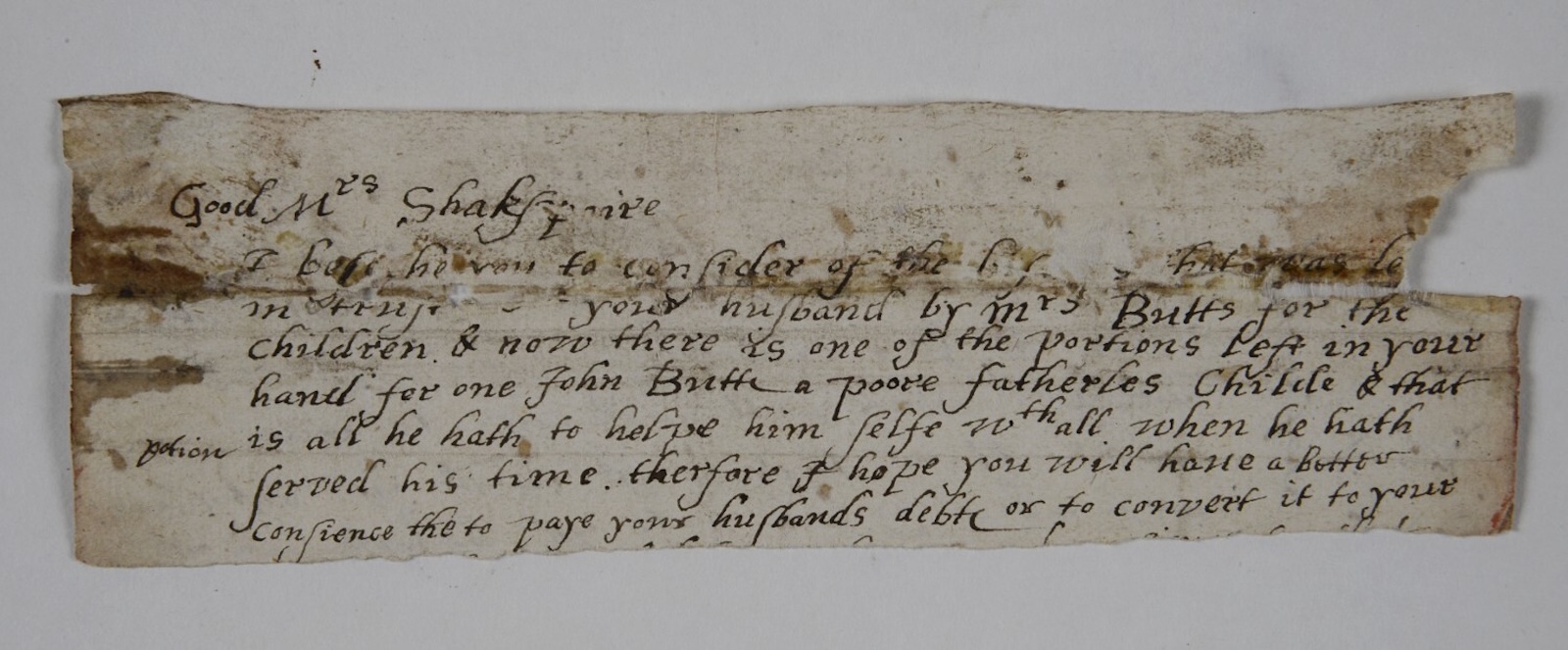
Hereford Cathedral and The Hereford Mappa Mundi Trust
The front side of the upper fragment of the letter to “Good Mrs Shakspaire” at Hereford Cathedral, circa 1603–1608
The book he was holding was published in 1608. If its calfskin binding was original, as it appeared to be, the letter would have been written sometime in or before that year—well within Anne’s lifetime (circa 1556–1623). The variant form of the surname was no obstacle: this was the era of orthographic fluidity (or “sportive spelling,” as the archival detective Leslie Hotson liked to call it). A letter to Anne Shakespeare would, of course, be a major discovery: she is a very famous name but a woman little known. There is certainly no surviving correspondence of hers; it is often suggested that she was illiterate. And if Mrs. Shakspaire was Anne, the interest of the letter would be compounded by its references—twice in the opening lines—to “your husband.”
These may have been Morgan’s initial reactions, but they didn’t last long. He was an old-style antiquarian scholar, a painstaking cataloger of ecclesiastical manuscripts and muniments. In his brief report of the discovery he struck a note of dry and dusty caution. No mention is made of Anne. His conclusion was austere: there were numerous Shakespeare families in England at the time, and “there can be no proof to which of [them] the letter was addressed.” It was an “interesting find,” but nothing more. It was also probably his last: by the time his report of it was published, in the October 1978 issue of Notes and Queries, he was dead.
After Morgan’s downbeat assessment, things went quiet. The intriguing bits of paper were tucked away, relegated once more to the lowly bibliographical status of “binding waste.” Their “host book”—Analysis logica omnium epistolarum Pauli (A Logical Analysis of All the Epistles of St. Paul) by the German theologian Johannes Piscator—settled back into obscurity. For decades almost nothing was heard of the matter.
Then, in 2016, there was a further discovery. Hereford Cathedral decided, not before time, to “disband” the fragments from the book for further inspection, and on the backs of them were revealed parts of a second letter, unseen by Morgan. It was in a different hand and seemed from its phrasing to be a roughly drafted reply to the first letter. It was thus, prima facie, written by Mrs. Shakspaire herself.
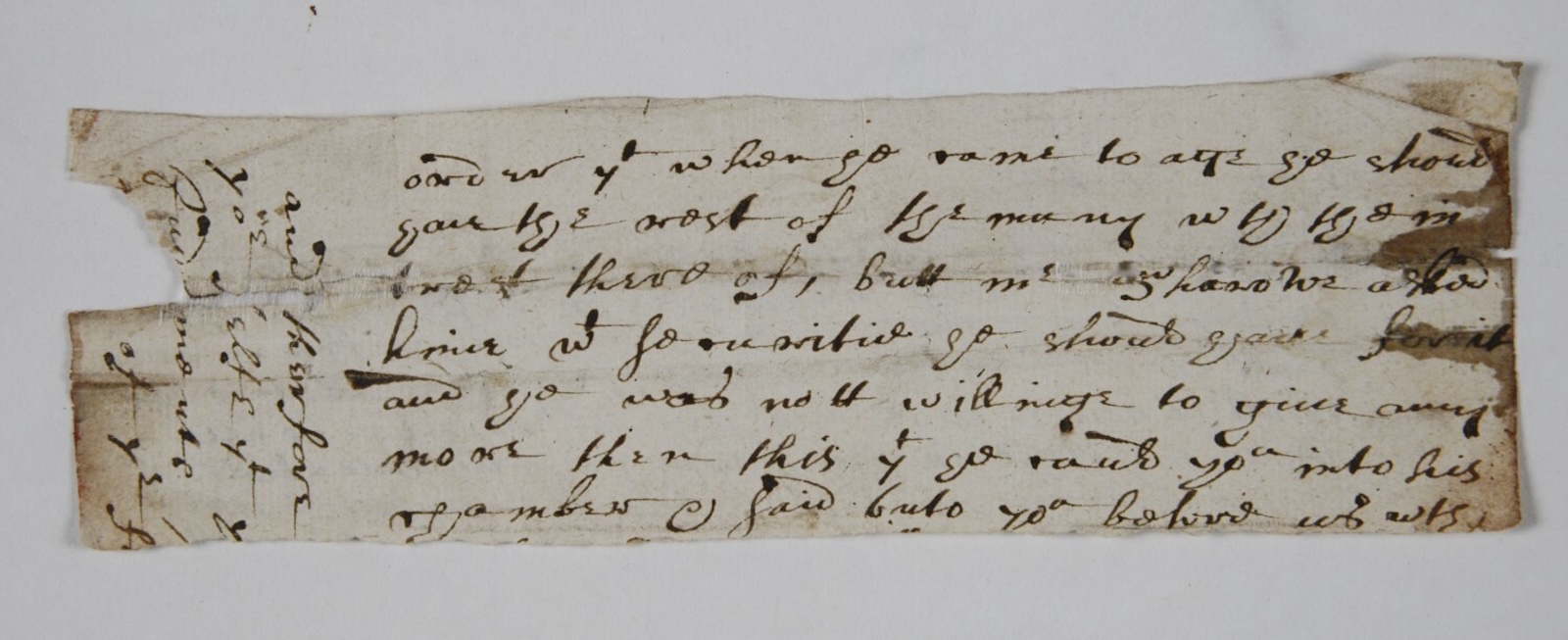
Hereford Cathedral and The Hereford Mappa Mundi Trust
The reverse side of the upper fragment of the letter to “Good Mrs Shakspaire” at Hereford Cathedral, circa 1603–1608
Two historians invited to evaluate the new finding, Mark Griffith and Edward Wilson, were unimpressed. They thought the same writer might have written both texts, one in formal italic and the other in the looser cursive script known as “secretary hand”—which is broadly plausible (educated writers did use both scripts) but much less so in this instance (they did not generally write replies to their own letters). And, like Morgan before them, Griffith and Wilson declined to speculate on the question of identity. “One would be right to describe the addressee of this letter as a Mrs Shakespeare,” they said, but no “link” could be established with Anne Hathaway Shakespeare.
*
Now, after nearly half a century parked up in this academic cul de sac, Mrs. Shakspaire is back in the news. In a detailed and wide-ranging investigation, published in the periodical Shakespeare, the scholar Matthew Steggle probes deep into the contents and circumstances of these alluring epistolary fragments. Steggle, a professor at the University of Bristol, decided to look into the matter for a book he is writing on Shakespeare. He is an accomplished literary detective and an expert in electronic research tools. His work as coeditor of the Lost Plays Database has put meat on the bare bones of hundreds of early modern plays known only by their titles. He is the ideal person to tackle the case, and he provides a powerful argument—if not final proof—that these Shakspaires are indeed Anne and William Shakespeare.
Advertisement
For the first time we have a full transcript of the fragments and as much sense of their subject matter as can be squeezed out of them. The letters concern a trust fund set up by a widowed mother, Mrs. Butts, for the future benefit of her children. Here is the text of the first fragment, with spelling modernized:
Good Mrs. Shakspaire, I beseech you to consider of the business [that] was left in trust [to] your husband by Mrs. Butts for the children. & now there is one of the portions left in your hand for one John Butts, a poor fatherless child, & that portion is all he hath to help himself withal when he hath served his time. Therefore I hope you will have a better conscience the [sic] to pay your husband’s debt or to convert it to your…
There the fragment ends, but already we have a gist of the story. One of the trustees involved is Mr. Shakspaire. He holds in trust a sum of money—a “portion”—now due to John Butts, who is about to finish his term as an apprentice. The writer hopes that Mrs. Shakspaire will discharge the debt on behalf of her husband, who has been slow and perhaps reluctant to pay up. The second fragment, cut from somewhere in the middle of the letter, adds a faintly threatening mention of law-courts.
None of this is thrilling, on the face of it, but what we learn about Mr. Shakspaire chimes with what we already know about Shakespeare—that in addition to being a world-famous writer, he was a very canny businessman: a theatrical shareholder, an accumulator of property, a signatory of deeds, an offerer of loans, and a plaintiff for their repayment. This is the “other side” of Shakespeare, whose only known item of correspondence is an incoming request not for a signed copy of Romeo and Juliet but for a surety of £30 to underwrite a business scheme.
In general terms, then, we would not be surprised to learn that Shakespeare had agreed to act as a trustee of John Butts’s legacy. But we need to know more. Who is this poor, fatherless apprentice, now anxiously awaiting the promised payout?
After much patient trawling Steggle has an answer. On December 17, 1599, he finds, a John Butts was apprenticed to a merchant tailor, Thomas Hughes, of Warwick Lane in London. He is described as a son of Thomas Butts, deceased, citizen and grocer of London. The stated term of his apprenticeship was eight years, thus running to late 1607. Apprentices did not always stay the course, but it seems John did, for in May of that year there is a separate record of him being punished for “disobedience to his mother and master.” This is certainly a close match with the young man in the letter. It also helps to date the letter, in which it is said that Butts will need the money “when he hath served his time.” This sounds fairly imminent, so the letter was probably written sometime in 1607, a date that accords with its presence as binding waste in a book published in 1608.
Unexpectedly, that book itself—Piscator’s Analysis Logica—has a connection with Shakespeare: not, once again, because of its theological contents, but because it was printed by his long-term acquaintance Richard Field. The son of a Stratford tanner, Field was Shakespeare’s schoolfellow at the local grammar school, and later the printer of his earliest published works, Venus and Adonis and The Rape of Lucrece. There is a good chance that copies of the Analysis Logica, produced at Field’s printing shop in Blackfriars, were also bound there (books were often bound by their printers, and Field’s former master had been an expert binder). So here is another “evidence cluster”—a letter delivered to Mr. Shakspaire’s wife in around 1607 turns up a year later, as waste paper, in the shop of Shakespeare’s friend.
The people that emerge from Steggle’s inquiry are Londoners: professionals, citizens. Butts’s late father was a “grocer of London”; his master is a merchant tailor on Warwick Lane, near Ludgate. Another person mentioned briefly in the letter, a Mr. Sharowe, remains ill defined, but Steggle finds a Thomas Sharowe living in the parish of St. Andrew by the Wardrobe, a few minutes’ walk from Butts’s workplace.
Advertisement
The scents on the trail lead to London, and a brief comment in the second fragment of the letter suggests that the Shakspaires were also to be found there. Looking back to an earlier period, when certain promissory bonds were signed by Butts’s trustees, the letter writer refers to that as a time “when you dwelt in Trinitie Lane.” Steggle gives many good reasons for identifying this former address of the Shakspaires as the London street Trinity Lane.
It is well known that Shakespeare lived much of his professional life in the metropolis, but here for the first time is evidence that at some period Anne was living there with him. We have only partial knowledge of his whereabouts. In the later 1590s, tax records show, he was a householder in the parish of St. Helen’s, Bishopsgate; he had left the area by 1598 at the latest. In about 1603 we find him lodging with a French family on Silver Street in Cripplegate. Between those dates his residence is undocumented. Was he on Trinity Lane? It was a respectable street, running southward into the busy thoroughfare of Thames Street. Nearby were the wharves and water taxis around Queenhithe Harbour, convenient for a regular commuter to Bankside, directly across the river, where the Globe had opened its doors in 1599.
*
The most generous reading of these fragments is that Mrs. Shakspaire is Anne Hathaway Shakespeare; that around the turn of the century, in her forties, she “dwelt” for some time in London with her husband; that she was not, therefore, as the mythos goes, permanently marooned up in Stratford; and that the letter sent to her in circa 1607 identifies her as Shakespeare’s partner in a business sense, a handler of his creditors and debtors, a channel of communication for people he didn’t want to speak with.
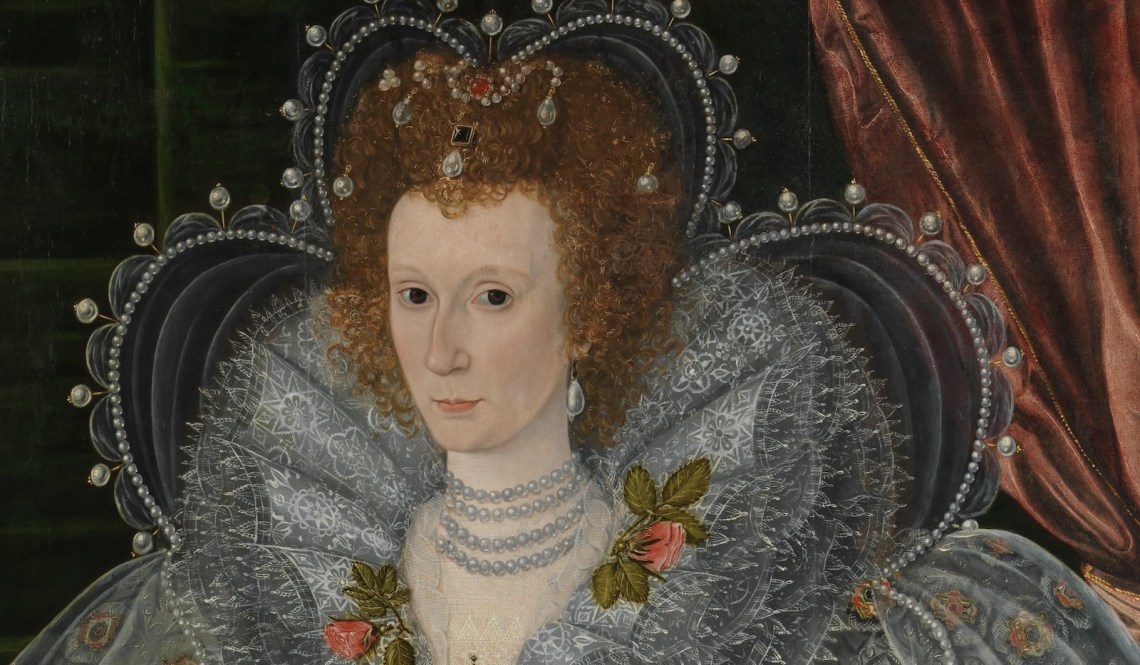
I think Steggle’s argument is strong: we are dealing here with the Shakespeares. We have a new episode in their everyday lives that also has some implications for their private lives. It gives us a sense of Anne that differs from the traditional morality tale of the farmer’s daughter and the genius, a saga that begins with a shotgun wedding and ends with the supposedly insulting bequest of the “second best bed,” and assumes decades of marital incompatibility in between. This misogynist narrative was challenged in Germaine Greer’s robustly revisionist Shakespeare’s Wife (2007)—which also suggested, perhaps presciently, that Anne’s household activities would have included acting as “a money-lender”—and in recent scholarly studies by Katherine Scheil and Lena Orlin.1 The story teased out by Steggle belongs with their rehabilitations of Anne. It offers a glimpse of her as they have argued her: a woman with her own identity and agency.
Most tantalizingly, in that drafted reply on the verso of the letter, we hear for the first time Anne’s voice. The fast, roughly formed handwriting could be hers—the more engagée she becomes, the more unlikely her alleged illiteracy seems—but even if someone else took it down for her, the phrasing would be hers. The text is very discontinuous, but here are some parts of it, unmediated by modernization:
When he came to age he should have the rest of the muny wth the intrest there of, butt Mr Sharowe…cauld you into his chamber & said unto you before us…you will answer it att the dreadfull day of Judgment that you see this muny paide…
One catches her tone: brusque, forthright, forceful. She is not just replying to the first letter, but flatly contradicting it. She recalls a meeting sometime in the past, at which “you” (the letter-writer) undertook in the presence of “us” (the Shakspaires and Mr. Sharowe) to pay Butts’s portion when it became due. In short, she is saying, we owe nothing to young Butts: it’s up to you to deal with it.
These letters are a fascinating window into Anne’s world. The view is narrow and highly specific, but the very ordinariness of the scene is historically precious. We find her unexpectedly in London; we hear her views on a financial matter; we gather that she is a tough woman to deal with. And with the firm stance of her reply there comes a slightly unsettling question about the Shakespeares’ conduct. Were they, as she claims, contractually justified in their refusal to pay up? Or were they just ducking and diving because they preferred to keep the “muny” themselves? It is often the case with this shadowy couple—as new light is shed on them, new conundrums arise.