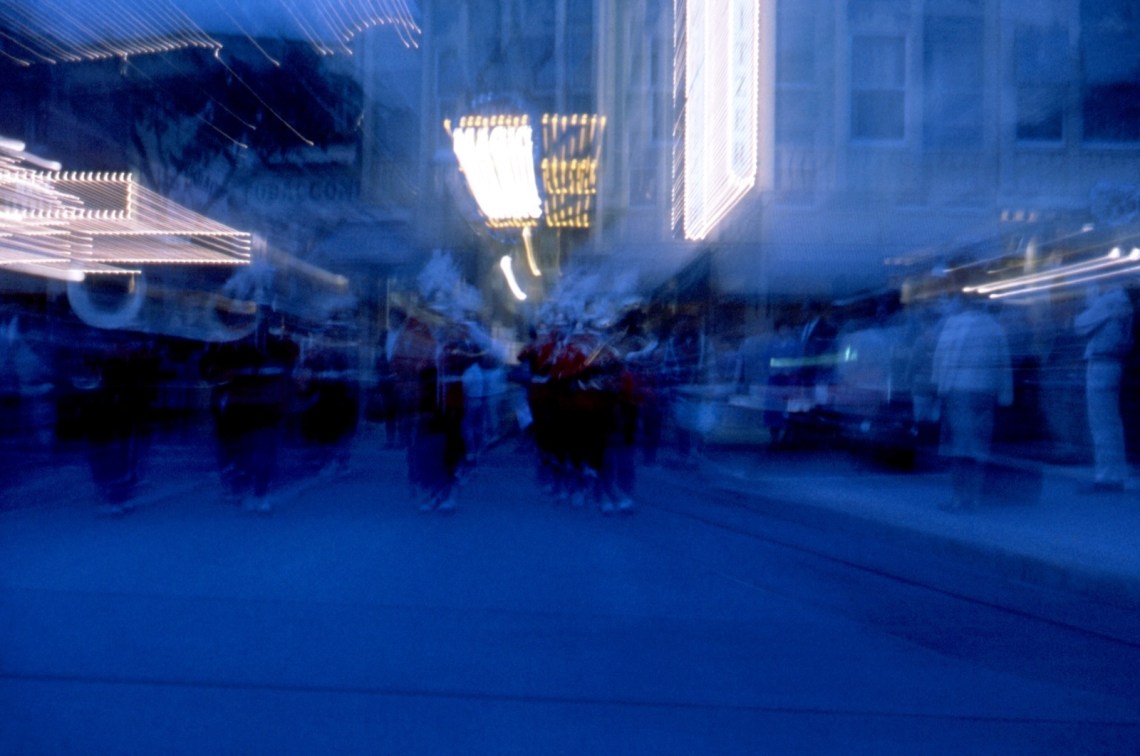
One summer evening when I was seven years old, my father packed my two brothers and me into our Opel station wagon and drove us to the edge of town. “Look,” he said solemnly, pointing to a ring of lights flickering in the distance. “That’s Disneyland.” We lived in Richmond, Indiana. It was 1962. My associations with the legendary theme park were vague (wild rides and exotic locales glimpsed on Sunday night TV’s Walt Disney’s Wonderful World of Color) but exciting. The lights on the horizon actually marked the construction site for the Gateway Shopping Center. Richmond liked to call itself the Gateway to the West, hence the mall’s moniker, but it was a long way to LA. My father was a kindly man, not given to wily humor or cruel deceit. What was he thinking?
I was recently reminded of this puzzling episode when I read Splendor of Heart, Robert D. Richardson’s 2013 tribute to Walter Jackson Bate, the Pulitzer Prize-winning biographer of John Keats and Samuel Johnson. A towering figure in twentieth-century literary scholarship, Bate was Richardson’s favorite teacher at Harvard during the 1950s. “I had never encountered anyone for whom literature mattered as much as it did for him,” Richardson writes. But when Bate visited Richardson’s family in Los Angeles many years later, he had no interest in the Huntington Library or UCLA’s rare book room. “He wanted to go to Disneyland, which he loved, he said, because it reminded him of the small town in the Midwest where he grew up.”
Bate grew up in Richmond, Indiana. How, I wondered, could Richmond, a drab rust-belt town of around 45,000, possibly resemble Disneyland, and not just for Bate but for my own father?
*
In Bate’s case, Richardson offered some clues. Bate, he wrote, liked the Disneyland ride called Huck Finn’s Raft, a careening romp down an artificial river. I’m guessing Bate also enjoyed Main Street, USA, a Disney facsimile of Spoon River, Grover’s Corners, and other fictionalized ideals of small-town America. For a man of Bate’s generation, and my father’s, Walt Disney, for better or worse, was a fabulist of national meaning. When Bate, at the start of his Keats biography, twice compared Keats’s humble origins to those of Lincoln (whom Bate revered), it was this America of near-mythical possibility he was drawn to, a world in which one could begin life “as characters in an older allegory do.”
Warner Berthoff, a Melville scholar I studied with at Harvard during the 1970s, informed me that Bate and I were from the same town. One day I ambushed the great man after a session of his wildly popular course, “The Age of Johnson.” “I hear we’re both from Richmond,” I said jauntily. Bate looked flustered, as though he’d been found out. I asked him what school he had attended. “Baxter,” he said. I mentioned that my own school, Joseph Moore, played Baxter in basketball and that I played on the Joseph Moore team. Silence. Then Bate mentioned the last time he’d been to Richmond, decades earlier. “I’ve never been back,” he said. Then he corrected himself. He had returned once to visit his mother.
It didn’t sound much like Disneyland. Was something clouding Bate’s memories? I got some answers in the long, hagiographic Memorial Minute a group of Bate’s colleagues published after his death in 1999. Here I learned that Bate’s father was superintendent of schools in Richmond. Had I committed a gaffe by asking what school young Jack (as he was known) had attended, as though I knew his father’s humdrum occupation? But there was a bigger cloud. When Jack was five, a hit-and-run driver left him badly injured in the street. Rather than call for medical help, his mother, a Christian Scientist, prayed as he nearly bled to death.
The accident affected Bate’s nervous system. As a young man, according to the Memorial Minute, he underwent an operation on his sympathetic ganglia, which control fight-or-flight responses like sweating and blushing. The sympathectomy, new at the time, was performed in the amphitheater at Massachusetts General Hospital with doctors and residents looking on, as in Thomas Eakins’s painting The Gross Clinic. Is it possible that Bate associated this operation with what he once described as the “special horror” in Thomas Mann’s novel Dr. Faustus, in which a composer sells his soul to the devil in order to produce great music? The Faustian pact requires him to undergo, Bate notes, the “destruction of part of his brain in order to free himself from the crippling inhibitions of self-consciousness.”
Invited in 1982 to write a brief overview of the status of his discipline for the Harvard alumni magazine, Bate inadvertently found himself at the center of the much-publicized “theory wars.” The humanities were in trouble, Bate warned in “The Crisis in English Studies,” as a result of a century of overspecialization and the loss of the old connection—so important for the poet Coleridge, on whom Bate wrote a fine monograph—between the arts and sciences. The problem was compounded by recent antihumanist incursions from France, which promoted “a nihilistic view of literature, of human communication, and of life itself.” It was this sweeping and ill-judged claim that embroiled Bate in controversy, with rebuttals by Paul de Man and Stanley Fish. Bate later regretted what he deemed his “superficial” article, which was never intended for a professional audience in the first place. He had written it, he told an interviewer, “in a deliberately elementary style, so that someone who was running a hardware store in Richmond, Indiana, and was a Harvard alumnus could get a picture of the thing.”
Advertisement
*
Bate has been on my mind lately. For an essay about an eighteenth-century teapot, I was trying to make sense of the transition from neoclassicism in England to the extraordinary outburst of Romanticism with Coleridge and Keats. I wondered how Keats could convert the rigid conventions of Pope and Dryden into his dynamic “Ode on a Grecian Urn” or how Coleridge could transform quaint British chinoiserie into “Kubla Kahn.” The ostensible subject of Bate’s brilliant, short book The Burden of the Past and the English Poet (1970) is this momentous cultural shift and its impetus: the prevailing sense that everything had been tried, with intimidating success, and that there was nothing left for an ambitious young poet to achieve.
But what I found in the book this time around, and what sent me to Richardson’s memoir, was something deeper and more intense. Bate repeatedly invokes the late Sixties as a time very much like the period when Keats and Coleridge came of age. He writes of “the present emerging generation” responding to “the dehumanizing pressures of an organized and increasingly crowded society.” What set the Romantics apart, Bate argues, was the “boldness of spirit” with which they faced their own dilemma. And that, in Bate’s view, is the only thing that will save us now.
While Bate was writing The Burden of the Past, there was an explosion on Main Street in Richmond, Indiana. It occurred on April 6, 1968, two days after Martin Luther King Jr. was assassinated and while riots were raging across the country. A gas leak under the Marting Arms sporting goods store caught fire, igniting the gunpowder stockpiled in the building (in anticipation of a race war, according to rumors at the time). I heard the tremendous blast as I was walking home, toting my viola, from quartet practice downtown, and watched with astonishment as a mushroom cloud bloomed over the city. The disaster, which killed forty-one people and injured more than 150, gave the town fathers a chance to turn the dilapidated street into a pedestrian mall—shades of Disneyland’s Main Street, USA—in order to compete with the Gateway mall outside of town.
My father, a Jewish refugee from Berlin educated in wartime London, had no particular fondness for Midwestern towns, and certainly felt no nostalgia for Richmond after we left in 1972. Best known today for his spiral arrangement of the Periodic Table, he was a chemist and historian of science with a mystical belief in the essential wonder of the natural world. Dashed off for a calendar published by the American Chemical Society, his spiral captured a more imaginative arrangement of the periodicity of the elements than the two-headed box on high school classroom walls.
After giving the matter some thought, I’ve come to believe that Bate and my father were responding to different aspects of Disneyland. For Bate it was a notion of the American heartland as a place of humble origins (Lincoln, Huck Finn, perhaps Bate himself) leading to extraordinary destinies. Bate’s Disneyland evoked a simpler, pre-industrial world. This was a major strain in the Romantic poets he loved so much, the nature-based lyricism of Wordsworth, say, or of Emerson, whom Bate quoted approvingly in The Burden of the Past: “I ask not for the great, the remote…. I embrace the common. I explore and sit at the feet of the familiar, the low.” I can easily imagine that it was this apotheosis of the ordinary that Bate was seeking on Huck’s Raft.
For my emigrant father, by contrast, Disney was the magician of American invention, the wielder of color, light, and technological progress. I picture him thinking of the opening fireworks of Walt Disney’s Wonderful World of Color, touched off by Tinkerbell’s wand. That sense of wonder, I now believe, is what he wanted his three sons to see on the flickering Richmond horizon that summer evening. To borrow a distinction from one of Bate’s heroes, Edmund Burke, Bate looked to Disneyland for the beautiful, the human-scale harmony of Main Street, USA. My father, by contrast, associated Disneyland with the sublime, that awe-inspiring sense of what eludes human comprehension in the design of the universe.
Advertisement
Today my memory of those deadly fireworks exploding over Richmond in 1968 blurs in my mind with my father’s fantasy of the illuminated Gateway mall (still standing, according to Mapquest, with an Aldi and a Hobby Lobby) as Disneyland. My father never did take us to the actual Disneyland. My wife and I never even thought of taking our kids there. And, unlike Walter Jackson Bate, I myself have never returned to Richmond, Indiana.