In a single large room at Tate Modern the South Korean artist Do Ho Suh is having his first major exhibition in a British museum. It has the feel of a condensed retrospective, however, partly because he has been so faithful to his obsessions that many of the pieces specifically made for it are also elements in an ongoing series. I went with my ten-year-old daughter, and as always when seeing a museum show, the surrounding experience seeped into the general impression. We paused at the bridge over the Turbine Hall. Below Louise Bourgeois’s implacable giant spider Maman, the British artist Monster Chetwynd had set up a kind of play installation for children hopefully called Thunder, Crackle and Magic, but really there seemed to be just the usual playground atmosphere: frenzied and depressive. And so we continued upstairs, past one of the museum’s many stores and a closed members’ bar, to the second floor.
Do Ho Suh was born in Seoul in 1962, moved to Providence in the early 1990s to study, lived in New York from 1997, and then about a decade ago moved to London. His art focuses on questions of home: what a home might be, where it might be located, what a perfect home might be, whether a home is physical or immaterial. He’s made paintings and drawings and films, but he’s best known for making replicas of places he has lived: architectural spaces in fabric or paper that are extraordinary feats of magical engineering. Three of these structures dominate the windowless room at Tate Modern.
The exhibition is called “Walk the House,” and according to one of the accompanying texts,
“Walk the house” is a Korean expression Suh heard as a young boy from the carpenters who constructed his childhood home in Seoul. The building was a traditional Korean house known as a hanok. These buildings could be disassembled and reassembled in a new location—a process of literally “walking the house.” For Suh, the phrase describes how we carry multiple places with us across space and time.
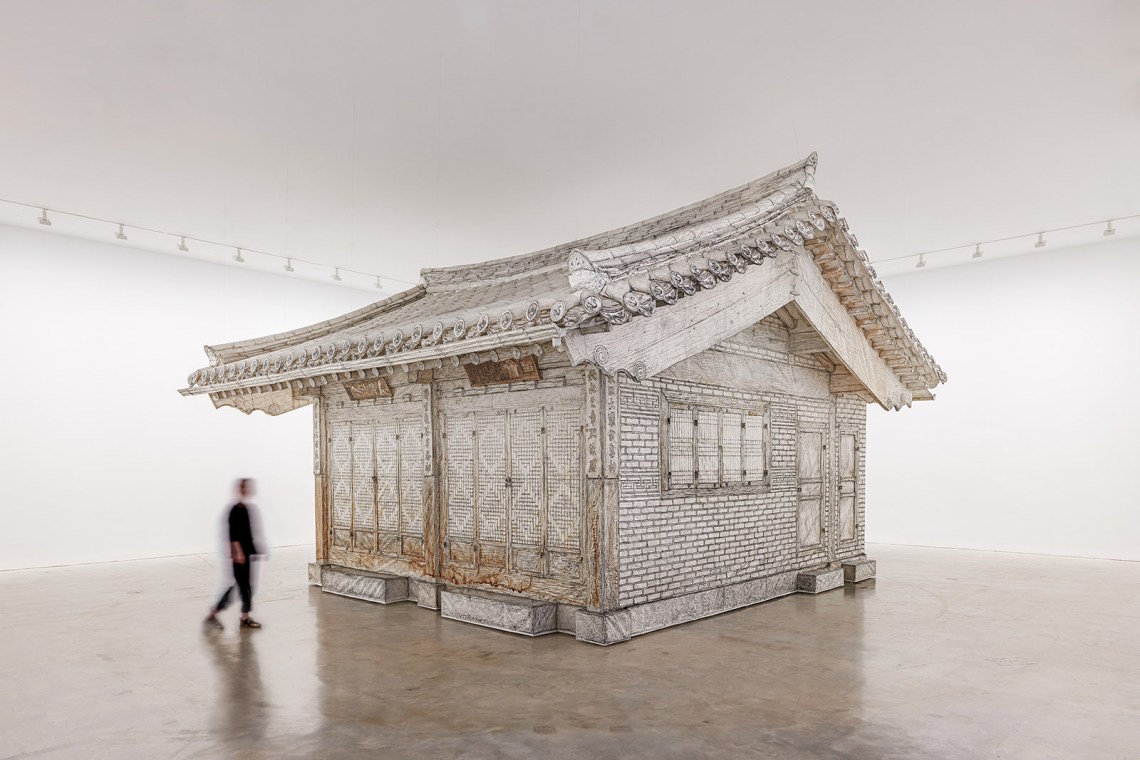
Suh explores that disassembly and reassembly in the most striking work at the Tate, Rubbing/Loving: Seoul Home (2013–2022). To make it, he entirely wrapped the hanok where he spent his childhood in large sheets of mulberry paper and rubbed away at it with graphite so that the underlying surface emerged. The sheets of paper were relaid on an armature, creating a perfect 1:1 reproduction of the exterior of the house.
The second structure, Nest/s (2024), is a sequence of interlocking spaces, an irregular tunnel that replicates bathrooms and entrance halls and passageways from Suh’s previous homes. It’s made of multicolored translucent polyester, like a tent, so the gallery outside is visible from within, just as the people moving through it are visible from the gallery. Its most notable characteristic is its fidelity to the small protuberances that proliferate half-unnoticed on our walls and ceilings: fire extinguishers, air-conditioning vents, toilet paper dispensers, motion sensors, strip lighting, fans… And these nonobjects are also the subject of the third structure, Perfect Home: London, Horsham, New York, Berlin, Providence, Seoul (2024), a colorless polyester reproduction of his current apartment in London, in which the walls are filled with details from previous homes—sockets, switches, bolts, alarm pads—all brightly color-coded to the different spaces he has lived in and placed at their precise height in their original locations.
Arranged around these structures are a few other works: earlier projects with rubbed surfaces, such as Rubbing/Loving: Company Housing of Gwangju Theater (2012), which moves from the personal to the political, since the work’s panels are reproductions of the surfaces of an abandoned space in Gwangju, the site of the Gwangju Uprising, a mass protest in May 1980 against the South Korean military government, which suppressed it with murderous violence and then denied it had ever taken place. Rubbing/Loving: Unit 2, 348 West 22nd Street, New York, NY 10011, USA (2014–2023) consists of vitrines containing 3D rubbings on paper in pale lemon pencil of elements from his New York apartment, not just sockets and brackets but also windows and louvered blinds. For Staircase (2016), Suh reproduced a staircase in red gelatin tissue paper and thread, then laid this onto wet sheets of paper, so the structure has shrunk and collapsed into a two-dimensional shape, and the banisters now look more like straps and laces from some kind of abandoned corset.
There are so many homes in this show! Home Within Home (Scale 1/9) (2025) is an architectural model in clear resin of two of Suh’s homes, his childhood hanok and the apartment building where he lived as a student in Providence, but the hanok has been embedded in the center of the apartment building in an imaginary feat of impossible engineering. In an annex, Suh has also displayed some research materials—an expanding archive of films and sketches and interviews, some of them reproduced in a kind of newspaper for visitors to take away—from his ongoing Bridge Project, which he began in 1999 and is described as
Advertisement
a research experiment suggesting bridges linking the places the artist has called home at different times in his life….
The project’s first iteration posits bridges spanning the North Pacific Ocean, linking Seoul and New York, where Do Ho rented an apartment from 1997. In the 2010s, the bridge expanded to include London following his relocation.
The so-called perfect home is the point equidistant between Seoul, New York, and London, which lies in the Arctic Ocean, near the Chukchi Plateau.
Finally there are two films being projected onto one of the room’s walls, Robin Hood Gardens, Woolmore Street, London E14 0HG (2018) and Dong In Apartments (2022). These were housing complexes in London and Daegu, South Korea, and both were demolished. Suh filmed apartments in each one: in London the residents had not yet moved out, so the rooms are still full of objects; in Daegu everyone had moved out before filming began, so the video shows melancholy rooms that resemble his fabric works, stripped of everything except the wall fixtures.
I felt a strange tenderness toward all this art. It was all too much—arranged a little too closely in this windowless room, in a museum on the banks of a river in a giant city, with wall texts that insisted on the works’ philosophical thinking—as if it were trying to transmit meaning but the channels were jammed and the audience was sparse. But in these videos’ juxtaposition of crowded detail and tattered absence, I began to think, lurked an interesting problem.
Because of the method Suh chose for reproducing the hanok of his childhood in Seoul Home—rubbing graphite on paper that seems to have become stained from rain during the long process—the multicolored surface of the house has been replaced by a sepia grisaille. It seemed a clue to a larger reversal: the method, while wonderful at offering up the patterns of materials and the decorations made by craftsmen, did something ghostly to the structure as a house. The problem was the openings. In this rendering through rubbing, the doors cannot be opened and the windows are all blocked. And a blocked exterior, it turns out, isn’t a house. As a definition of a house, it functions only negatively. You are only at home if you are inside.
On the other hand, a house that is almost all interior but whose walls are transparent, so that the solid has become diaphanous, isn’t a home either. There was nothing less homelike than these reproduced homes—not the Seoul Home, not Nest/s, not even Perfect Home. “I chose fabric for the architectural pieces because the translucency means that you can bring the surrounding space into the piece, blurring the boundary between the artwork and visitors’ bodies,” Suh has said. But is blurring really what was happening in this room?
There were security guards waiting outside both Nest/s and Perfect Home, one or two at each entrance, who instructed us not to touch anything and to keep all bags hung at our fronts. I mention this mundane aspect of contemporary museum-going because although I accepted it as part of the experience, my daughter was not so practiced in it and found it strange to be offered a game that was also highly policed, and I wondered if in her perplexity she was being the more precise. The art advertises itself as generous, but the experience was not generous. The same was true of the way the art was being explained to us:
Suh’s works remind us that everything is connected—we exist within a network of relationships and experiences. As you explore, you may begin to wonder what spaces and times you carry with you as you move through the world. How does architecture shape and hold our memories? And in a world increasingly defined by movement—voluntary and involuntary—where and when is home?
It’s a form of discourse, I was thinking, that wishes to be open but is in fact strangely coercive, and that manner of speaking also seems inconceivable outside a gallery space.
The fact that we could walk inside the structures didn’t seem like freedom, and so it also didn’t feel like there was any blurring of the artwork and our bodies. At every point the demarcations were obvious. Through the transparent material you could see the apparatus of the gallery: the bored guards, two of whom were arguing over something one of the other guards had said to them on a previous shift, and the other gallery visitors, all moving at that special walking speed that only happens in a gallery, pensive and hesitant, as if suddenly embarrassed at how fast they wanted to go.
Advertisement
A gallery is a nonspace, a place that makes it difficult to know where to place yourself, it isn’t homelike either, and the works seemed too abstract to overcome that sense of dislocation, or too diffident. In this atmosphere, I began to feel confused by the colors. The gossamer structures of Nest/s and of Perfect Home are rendered in technicolor fabric, a sort of Pantone utopia, and these colors seem crucial to how seductive the works are. But at the same time Suh seems to disavow this—“I really just worked through the shades,” he says in a conversation printed in the show’s catalog—as if the visual pleasure the colors give, both in a gallery and in reproduction, is almost unmentionable.
The model for these forms is the architectural drawing, deliberately weightless and ethereal. This is why the minor details—the decorative carving on the outside of the hanok or the many functional fittings set into the walls or ceilings of apartments—acquire unusual gravity. But maybe there was less contrast than there first seemed. Those fittings, for instance: I realized that I couldn’t give many of them a name. They are just the million details that are relevant not to the people who live in these spaces but to the architects and engineers who build them. They remain specimens rather than individual objects.
This was what was preoccupying me as I watched the two films of the apartment buildings about to be demolished. As the camera slowly moved through the apartments of Robin Hood Gardens, I found myself mournfully drawn to all the objects that would soon be removed: a duvet, a suitcase on top of a filing cabinet, a gym bag, a bike on a wall, unmade beds, plastic bags stuffed with invisible objects, curtains hanging sloppily off some rings on a curtain rod… These were all the things missing from the pretty structures in the gallery, and their absence felt like a problem. The artworks wanted to be toys for thinking, they wanted to raise questions of home, of where or how a home can exist, and this thinking is of course politically unimpeachable in our desolate era. But what really allowed for reverie were these plastic bags, these faded curtains—not the Pantone sockets or locks of the polyester monuments.
What opens out is the minute detail.
In 2014 Rem Koolhaas directed the Venice Architecture Biennale and devoted the Central Pavilion to an exhibition called “Elements of Architecture,” which explored the basic units of a building: the floor, the wall, the ceiling, the roof, the door, the window, the façade, the balcony, the corridor, the fireplace, the toilet, the stair, the escalator, the elevator, and the ramp. As part of the exhibition, the artist Wolfgang Tillmans made a brilliant two-channel video installation, Book for Architects: a series of 450 photos, selected from the archive of his previous decade’s work, of the exteriors and interiors of buildings from across the world. Whereas the exhibition followed a stern series of typologies, Tillmans’s photos are ordinary and shabby and hectic. The basic elements of Koolhaas’s analysis are sometimes visible in them, but what’s most striking is the clutter of human details: the TV screen set up at an angle to a room, the comical clock on a wall, the position of a tattered sofa.
I found myself thinking about these photos as I stood among Suh’s structures, with the images from his films softly visible behind a screen. Why, I wondered, did I feel so much more drawn to Tillmans’s work? Both artists, after all, are concerned with the international, with trying to understand our domestic environments in relation to movement and displacement. And it wasn’t that the photos by Tillmans contained a larger wisdom—what was demonstrated in them is also demonstrated through its absence in these works by Suh: that all homes are in fact irretrievable, that a home is not its floor plan, that a home is a temporary arrangement that can only be imperfectly transported. But in Book for Architects the shabbiness seemed to allow for more complication, whereas the danger of Suh’s soft abstraction was that all the thinking had been done already, and there was nothing left for the audience to do.
It felt like so much was at stake in these light fittings and plastic bags in a single gallery room! I left unsatisfied, and for a long while afterward I was preoccupied. It seemed strange that similar recent works were so little mentioned in the exhibition’s accompanying materials—most obviously Rachel Whiteread’s House (1993), her concrete cast of the inside of a three-story London house that was about to be demolished, or Christo and Jeanne-Claude’s wrapped buildings—works concerned with outlines and silhouettes and residues. I don’t mean that Suh’s works are in any way derivative. It was more that the absence of these other works seemed to be part of the show’s anxiety about position.
Suh has said something beautiful about his feelings while making his rubbings:
The instant I’ve masked that surface, I can no longer remember what exactly is behind it. It’s like a form of dementia, almost: I’m aware that I know what’s under the paper, but I don’t have access to the memory. And when I start rubbing, things rush back.
The problem with this kind of memory retrieval is how private it can remain, and it felt like a hint toward the larger problem, which was the works’ anxious desire for the universal, or international. In their catalog essay, the curators Nabila Abdel Nabi and Dina Akhmadeeva relate the Tate’s first acquisition in 2011 of a work by Suh, his Staircase-III (2010), to the institution’s ongoing effort “to reconceive the museum as a polyphonous, transculturally constituted entity.” The work, they add,
orients our attention to the manifold ways we inhabit space at any one time, and the ways in which artists always bridge the distinct time-spaces they speak from with all the spaces they move through.
This ideal of mobility, of course, has always contained the danger of complacency, and Suh has always been careful to distinguish his own voluntary movements from the forced displacements of world politics. The beauty of his work is that it so finely balances the portability of both an artwork and a home between a utopian possibility and a tragic necessity.
But something in that museum room still felt trapped, as if it had further to go. Maybe you have to go much smaller, almost minute, to find the shimmer of the truly transnational—a form that can produce nostalgias and reveries in any neutral global space. What I remember now isn’t really the sockets or appliances from his bright apartment replicas but a single moment from his video of the Dong In apartments: in the mess of a stripped-out room, a single tap emerging, pointlessly, from a wall.