There are only a few surviving recordings of the photographer Peter Hujar’s voice. In the portion of his archive at the Morgan Library in New York, a fifteen-minute tape of a hypnosis session—Hujar was always trying to quit smoking—records his unconscious fantasies about sleeping with the photographer Robert Mapplethorpe, his long-time nemesis. It has a lurching hilarity, as a dozing Hujar contends with this secret desire for an artist whose work he often mocked and dismissed. In his waking life, the presence of a recorder or microphone could make Hujar somewhat nervous, and he was usually less open. During a long interview with the artist David Wojnarowicz in the 1980s, he said he felt “jumbled by the machine,” self-conscious. Their conversation, never published though parts of the audio are currently available on the Wojnarowicz Foundation website, is full of stops and starts as the photographer tries to find his footing. He never quite does.
Hujar knew the power of words, and the spaces between. He chose them carefully. When he was asked to lecture at a photo club on Long Island, he stood in silence at the podium until the programmer intervened to ask him a few questions. The club was unsure whether Hujar had been anxious or trying something out on them—perhaps a Cageian experiment. Probably both, his friends thought. “Peter embodied one of the great secrets of being mysterious,” recalled Robert Levithan, a boyfriend from the mid-1970s who was present at the photo club talk: “If you’re tall, good-looking, and quiet, everyone will make up a very powerful story about you.”
Hujar made a notable exception to his reticence at the microphone on the morning of December 19, 1974, when he allowed the novelist and editor Linda Rosenkrantz—a friend since the mid-1950s—to tape him monologuing about the day before. The recording was supposed to be part of a series of interviews in which Rosenkrantz would ask her friends to recall a single day in their lives. It followed several similar projects: during the summer of 1965, for instance, she recorded her friends on East Hampton and cut the 1,500-page transcript down into a tight novel of gossipy, frank dialogue (“Which of your abortions was your favorite?”), published as Talk in 1968. Though she taped Hujar that summer, too, he appears only indirectly in the book as “Clem Nye,” a composite of Hujar and his friend and former lover, the artist Paul Thek. Her next manuscript, a series of recorded dinner conversations with ex-boyfriends, remains unpublished. As for her day-in-the-life project, only Hujar, Chuck Close, and a few others ever sat for interviews, and Hujar’s transcript was largely forgotten until the researcher Marcelo Gabriel Yáñez rediscovered it in the Hujar archive in 2019. (The original recording has yet to surface.) When Magic Hour Press published a lightly edited version of it as Peter Hujar’s Day (2021), Vinson Cunningham, writing in The New Yorker, called the little book “pure, ear-tickling pleasure.” As of this writing, it has gone into four printings.
*
Rosenkrantz recorded Hujar at something of a turning point in his career. He had worked as a commercial photographer for more than a decade, and he was largely unsatisfied with chasing invoices and conceding to the compromises demanded by editors and brands. His sense of rough-hewn glamour (drag queens, downtown performers, experimental artists) was not an easy fit with glitzy fashion spreads in Harper’s Bazaar or GQ, two of his clients in the late 1960s. Except for his portraits of musicians, whom he was particularly adept at capturing for record labels and rock magazines, his commercial photography was far less remarkable than the pictures of animals, lovers, and downtown performers upon which his reputation now rests. “My career at Bazaar is not memorable,” he once told a journalist.
That had begun to change by the summer of 1974, only a few months before Peter Hujar’s Day was recorded, when he showed several photos—including pictures of New York nightlife, his 1963 series of the Palermo Catacombs, and Candy Darling on Her Death Bed (1973)—at the Floating Foundation of Photography, a photo club on a barge docked at the 79th Street Boat Basin. It was his first gallery presentation. In a review, The Village Voice highlighted his work as “outstanding,” and Rock Scene called him “NY’s favorite photographer.” Afterward, Alex Coleman of Foto Gallery curated him into a two-person show with Christopher Makos.
Hujar had become a great portraitist of friends, artists, performers, and animals; he chronicled affinity, coterie, and the city itself, from parades and protests to backstages and bedrooms, usually his bedroom. Among the most appealing qualities of his work are its great intimacy and extraordinary depth, even across the species divide—his camera communed as closely with a horse in West Virigina in 1969 as it did with a lover in Manhattan in 1974. The artist Ann Wilson, a frequent subject, remembered that, sitting for him, “you felt yourself go through these veils of awareness until the point where…he summoned you to some place that was a nice place to be, or it was where you were.” His longtime friend Susan Sontag once wrote that she was “moved by the purity and delicacy of his intentions.”
Advertisement
Peter Hujar’s Day takes place two weeks after the Foto Gallery show opened. It begins on a note of hesitation: “I got up,” he opens, “I had completely forgotten this, actually, that you wanted me to do this, so I wasn’t writing it down and I sort of re-remembered it when you called me.” Rosenkrantz tells him to speak a little louder, so the machine can pick him up. “That’s the way I talk, hon.”
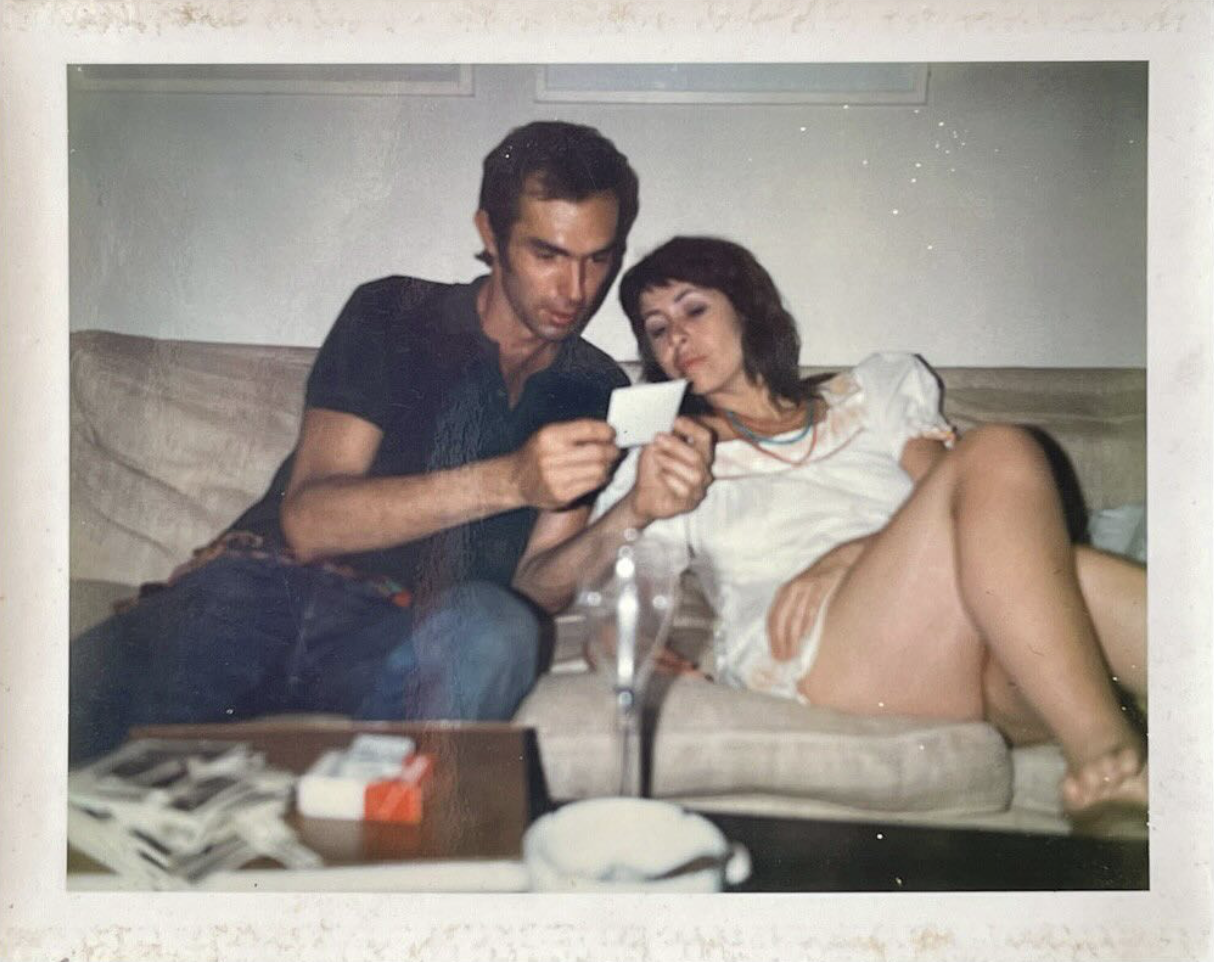
Linda Rosenkrantz
Peter Hujar and Linda Rosenkrantz
Yet for the next thirty or so pages Hujar is remarkably forthright and chatty as he recalls his busy day as a working artist: after breakfast, an editor for Elle magazine drops by to pick up some portraits of the model and actor Lauren Hutton, who once compared the quality of Hujar’s photography to that of Richard Avedon and Irving Penn. Sontag calls to say she’s heading downtown to see his show at Foto Gallery. Later that afternoon he shoots a rather uncooperative Allen Ginsberg for The New York Times. After some back-and-forth, Ginsberg demands to be photographed where he had recently been mugged; the pictures, shot on the street and in Ginsberg’s apartment, ultimately fall flat. “There’s very little there,” he tells Rosenkrantz. “There’s no contact.” During the session Ginsberg advises Hujar how to warm up William S. Burroughs for a portrait (“suck his cock”) after he learns that Hujar will shoot the novelist the following day. (The portrait of Burroughs lying down in bed is one of Hujar’s greatest pictures, capturing the writer’s strange, babyish innocence.) Later, after the session with Ginsberg, the writer Glenn O’Brien calls (a few hours before knocking on Hujar’s door unannounced), and the music and photography critic Vince Aletti stops by for a shower and some Chinese food. So much happens, so many names leap out, yet for Hujar—one of the mainstays of the downtown scene—it was a day like any other. He didn’t think he had done “anything,” he confesses to Rosenkrantz.
After dinner Hujar works in the darkroom, then practices the harpsichord. He can’t sleep—the sound of sex workers talking on Second Avenue carries to his loft. The final lines of the transcript place him at his window: “I watched them to see what they looked like and one of them was putting on makeup in the dark in the mirror of a car…” Here he revises himself, something he does throughout the transcript, either to correct a small fib (one theme of the conversation is his penchant for white lies) or, always the portraitist, to improve an image: “Actually, it wasn’t a car, it was that blue truck that comes from the junkies’ detention place up the block and it has a small rectangular mirror.” The transcript suddenly ends: “And then I went back to bed and fell asleep.”
Rosenkrantz seldom interrupts other than to offer a small comment or prod for further detail, though generally Hujar is very thorough. His longtime friendship with Rosenkrantz—they had known each other since their early twenties, and for years he had confided in her, trusted her, believed in her—must have contributed to his comfort in front of her microphone. He plies her with colorful detail and funny asides; his observations are wry, often exacting, sometimes erotic. He fantasizes about sleeping with the Elle editor, right there on the floor of his apartment: “She would be very raunchy and reach for my buttons.” He dwells on Sontag’s concern at possibly being recognized by the director of Foto Gallery—her enormous fame had catapulted her over many old friends like him—and on Ginsberg’s “ummpatumpum” schtick. He remembers spying the doodles of a man waiting for his chow mein order at the Chinese takeout and riffs on Aletti’s love of fast food. “He lives on Coke,” he says. “He does not eat good, Vincent.”
This is Hujar at his most personable and easygoing. He can be very sweet, very funny, and very self-deprecating. At forty, he is still ambitious, and he sometimes circles back to his hopes for his career, occasionally sounding like a younger artist. “You know I’ve always had a star thing, wanting to be some kind of a star,” he says. His two recent shows had begun to shift his thinking about his work: before this moment “the art thing was just an inkling,” he told Fire Island Newsmagazine. “I didn’t want to think of it as art.” Few photographers did. Photography was still seen as a secondary art form at best by most curators, art dealers, and fellow artists—it hardly sold, and for not very much. It wasn’t until 1971 that Artforum published a photographer, Diane Arbus, on its cover, and major museum retrospectives were still rare.
Advertisement
No works from the Foto show sold, but Da Capo Press invited Hujar to publish his first and only monograph, Portraits in Life and Death. Doing the book, which he immediately recognized as a significant opportunity, was already on his mind when he sat for Rosenkrantz. He wonders whether he should include the Ginsberg or Burroughs portraits, and who should write the introduction. Naturally, he thinks of Sontag. If her name appeared on the cover, the book would sell, he reasoned. He confesses to Rosenkrantz that he would love to make some money off it, and for the book to boost his reputation. While Sontag eventually agreed to write the introduction, which she drafted in her hospital bed on the eve of a major cancer surgery, the book did not sell well; it became a collector’s item until it was finally reissued last year. Hujar died an artist’s artist, revered, but little-known outside of the downtown scene and its admirers. Today he is widely regarded as one of the greatest portrait photographers of the second half of the twentieth century.
*
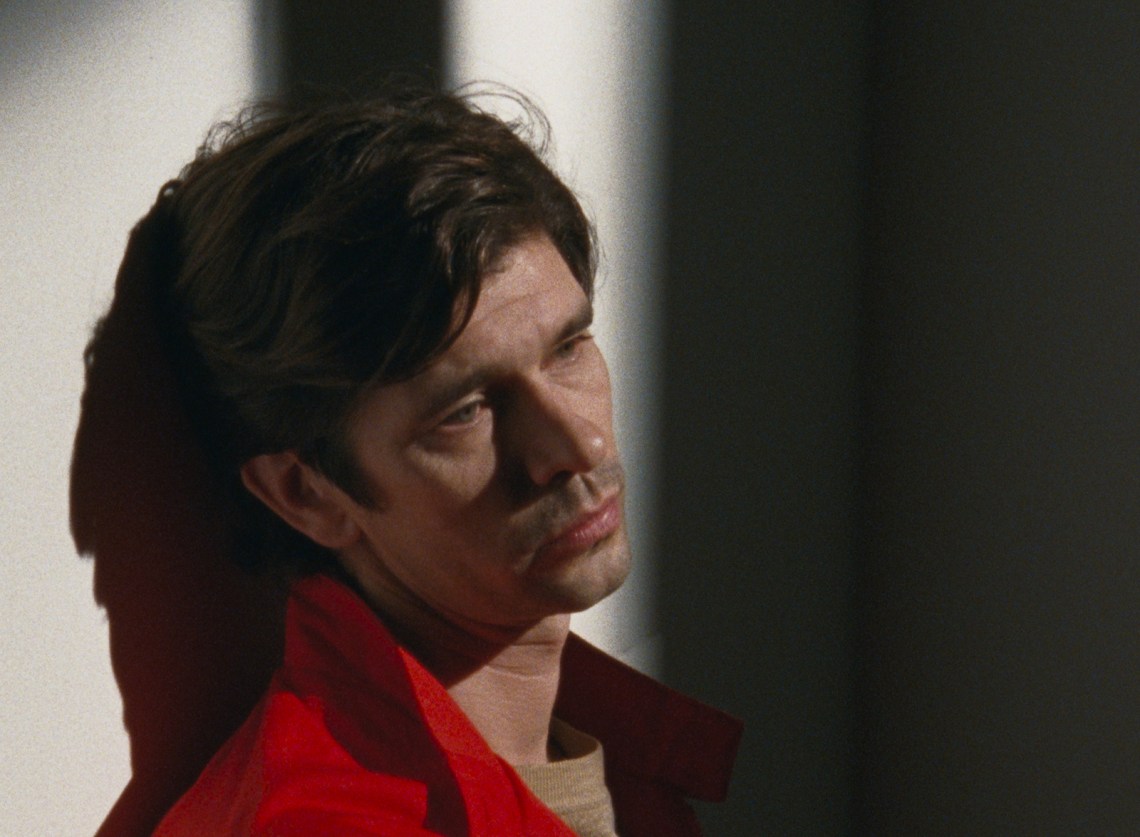
About fifty years after Peter Hujar’s day, the filmmaker Ira Sachs has adapted the transcript into a feature-length film starring Ben Whishaw and Rebecca Hall. Except for a few small tweaks (the opening lines, for example, where Hujar is told to speak up, have been scrapped), the film follows Rosenkrantz’s text closely. Shot at Westbeth Artists Housing in the West Village—a stand-in for Rosenkrantz’s actual apartment on East 94th Street—the film follows the two friends as they move about Rosenkrantz’s home and onto the building’s roof, where the cold winter light fades over the river behind them. There are no flashbacks, no recreations of Hujar’s day. The camera remains largely focused on Whishaw as he faithfully delivers Hujar’s words—an homage of sorts to Shirley Clarke’s nonfiction masterpiece, Portrait of Jason (1967)—while Rosenkrantz listens intently, a tape recorder humming beside them. Filmed by Alex Ashe on gorgeous, grainy 16mm film, the movie is punctuated by self-reflexive gestures—a clapper board announces the opening scene; the picture sputters and pops throughout—that seem to present it as an analog artifact, like a photograph printed in a darkroom: this may have been life, but it is only an image, a fiction, now.
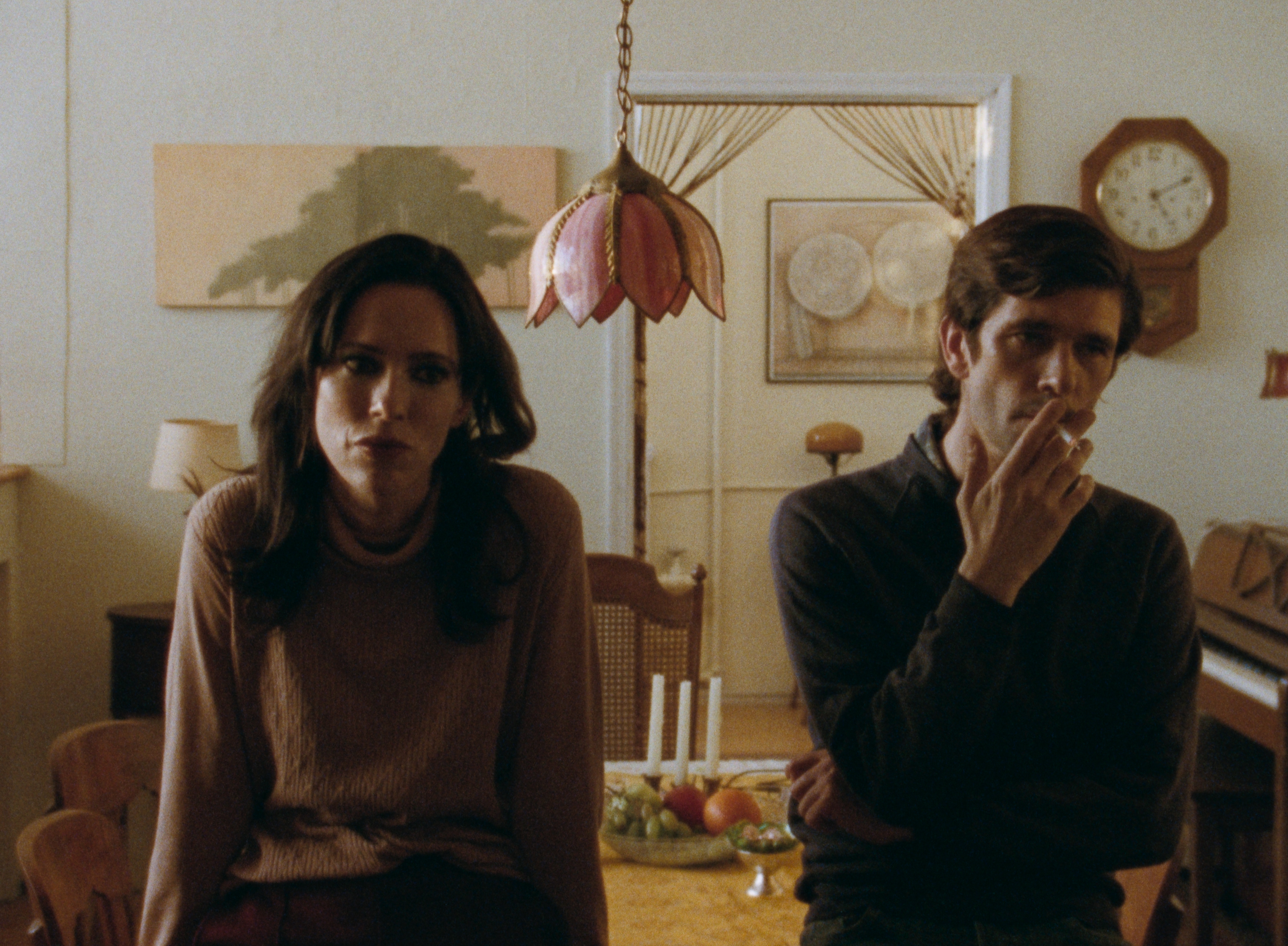
Janus Films
Rebecca Hall as Linda Rosenkrantz and Ben Whishaw as Peter Hujar in Ira Sachs’s Peter Hujar’s Day
There are two significant breaks from the monologue, neither of which appear in the transcript. In one cutaway Whishaw and Hall pose for a double portrait, with Hall casting a cold eye at the camera and Whishaw staring off into the distance—an oddly stagey moment (set to blaring Mozart) that may have been intended as a nod to Hujar’s soulful portraiture but resembles neither his artistic nor his commercial work. One of Hujar’s abiding interests was photographing couples and groups, tracing the unspoken affinities between people; in Sachs’s staging there is none of the mystery of connection. Instead the scene borrows too much from fashion images, exactly what Hujar was rejecting at the time. The second interval, far more successful, has Hujar and Rosenkrantz dancing to “Hold Me Tight” by Tennessee Jim. When they were much younger the two friends often went dancing together. Here, in their jangly movement, a faint memory of that past rises to the surface, this time animating far older bodies. It is surprisingly lovely, all the more so for Whishaw’s awkwardness.
Hall, who worked closely with Rosenkrantz as a voice coach, sounds remarkably like the novelist, nasally and dry. To my ear, Whishaw is rather too wistful in his interpretation of Hujar’s northeastern lilt, and he seems uncertain how to land the artist’s understated humor—a problem throughout the film. His subtle satire of Ginsberg, for example, loses some of its comic power. In these moments the real Hujar’s boots seem a little too big for Whishaw. Yet at times Whishaw’s uncertainty plays well: when he complains about chasing invoices he nails Hujar’s smoldering frustration, which rises out of nowhere—the real Hujar had a sudden and severe temper—with its psychic interplay of confidence and self-doubt. This is the Hujar who has recently left behind that “unremarkable” commercial career and begun to consider himself an artist. It is also the Hujar who cannot quite believe his own story is interesting: “So, is it boring?” he asks Rosenkrantz about his day. “No, it’s not boring to me,” she replies.
Elsewhere Whishaw’s interpretation of the photographer is a touch too serious, almost reverent. Toward the end of the film, when Rosenkrantz and Hujar lounge in bed while discussing his work—can it stand the test of time without famous subjects?—and whether they might go out of their way to see Joan Crawford on the street, Whishaw recasts in overly earnest tones what reads, in the original transcript, like deadpan gabbing. Why is Hujar suddenly so whispery as he recalls a scene, he thinks from King Kong, in which giant waves flood Herald Square?1 The film repurposes these offhand lines as an emotional climax, but the dialogue doesn’t seem to support it. Another Hujar is lost to the overly serious here: the Hujar who adored camp.
*
One of the great strengths of Sachs’s film is the changing light as the conversation progresses from afternoon to evening. At dusk Whishaw and Hall are suffused with a poignant, almost nostalgic glow, before the fading day outside gives way to the apartment’s dim electric lights. At the end of the movie Whishaw’s Hujar sits in a chair, half submerged in shadow, his face partly lit by a lamp. He returns to those unsatisfying Ginsberg photos. There may be one or two he can work with, he explains to Rosenkrantz, if he can draw out certain qualities of the images in the darkroom. She nods along; she knows his work, she knows what he can do.
Hujar was a master printer: in the darkroom he used a range of techniques to control how an image’s narrative unfolded for a viewer. A fine brush dipped in a potassium ferricyanide solution allowed him to bleach certain elements, while black ink eliminated distractions, like speculars. He would spot out imperfections, or sometimes leave them in, if the picture demanded it. He dodged to lighten, burned to darken. He changed the contrast by using a particular grade of paper.
“His decisions were always in the service of refining the meaning of the images,” the photographer and printer Gary Schneider wrote in a book about Hujar’s darkroom process, “rather than in an effort to simply make more beautiful tones. The story he wanted to tell was what the subject meant to him.”2 At its best, Sachs’s stripped-down film is not unlike one of these portraits, capturing an individual in a particular moment in time, without much explanation about who he was or why he was there. “Even in the quality of the face, where in one print the person will look completely different,” Hujar explains to Rosenkrantz, “it’s like adding something, forcing something to happen, which is interesting.”